

Waterfall islands are not automatically outdated, but they are no longer the right answer for every kitchen. Their success now depends less on following a trend and more on whether the stone, room size, cabinetry, budget, and daily use genuinely support the design.
A waterfall island extends the countertop material vertically down one or both sides of the island. When the slab movement is planned carefully, the result can look sculptural and custom. When the material is too busy, the seams are poorly matched, or the island overwhelms the room, the same feature can feel forced.
We discuss this often with homeowners selecting kitchen countertops in Hartwell, GA because a waterfall edge adds material, fabrication time, installation complexity, and cost. It should improve the room, not simply prove that more stone was used.
At Anderson Granite & Marble Shop of Greenwood, we help homeowners decide whether a waterfall island fits the kitchen before the slab is cut.
Are waterfall islands actually going out of style?
No, waterfall islands are not going out of style, but homeowners are becoming more selective about using them.
For several years, waterfall edges appeared in almost every modern luxury kitchen. That visibility made the feature feel special at first, then familiar, and eventually predictable in some projects.
Today, the strongest waterfall islands feel integrated into the architecture. The stone relates to the cabinet color, flooring, lighting, and room scale. The feature has a clear purpose rather than being added automatically.
A simple island with a standard overhang may look more current than a poorly planned waterfall. Restraint can feel more expensive than excess.
Why can a waterfall island feel overdone?
A waterfall island can feel overdone when it adds visual weight without improving the design.
Stone is a strong material visually. Extending it down both sides creates a large uninterrupted block that immediately becomes the focal point.
That works in a spacious, open kitchen with simple cabinetry. It can feel heavy in a small room, especially when the slab has bold veining, the floors are patterned, or the backsplash is already dramatic.
Common reasons the design feels excessive include:
- Using highly dramatic stone on every visible surface
- Adding waterfalls to a small island
- Pairing bold stone with busy cabinet grain
- Ignoring how the side panels meet the floor
- Choosing the feature without considering seating
- Using poor vein alignment at the corners
The waterfall should organize the room visually, not make every other element compete for attention.
When does a waterfall island still look expensive?
A waterfall island looks expensive when the stone movement, corner fabrication, proportions, and surrounding finishes are controlled carefully.
Luxury comes from execution. A clean mitered edge, balanced slab layout, and natural continuation of the pattern can make the island feel carved from one substantial piece.
The effect works especially well when the rest of the kitchen is calm. Flat-panel cabinets, simple hardware, restrained lighting, and a quiet backsplash allow the island to become the statement.
For homeowners comparing kitchen countertops in Hartwell, GA, we recommend looking at the island as a complete object. The top, sides, seating, outlets, floor connection, and surrounding walkways all matter.
Which materials work best for waterfall islands?
Quartzite, marble, dramatic granite, and premium quartz can all work well, but each material creates a different result.
Quartzite offers natural movement with strong heat and scratch resistance. Marble provides softness and classic veining, although it requires more maintenance. Granite gives the island durability and natural mineral variation. Quartz offers predictable patterning and lower maintenance.
| Material | Visual effect | Maintenance | Main concern |
|---|---|---|---|
| Granite | Natural, durable, grounded | Moderate | Pattern alignment |
| Quartz | Controlled and modern | Low | Repetition can look printed |
| Marble | Soft and luxurious | Higher | Etching and staining |
| Quartzite | Dramatic and natural | Moderate | Higher material cost |
At Anderson Granite & Marble Shop of Greenwood, we evaluate the material not only for appearance but also for handling, fabrication, and long-term use.
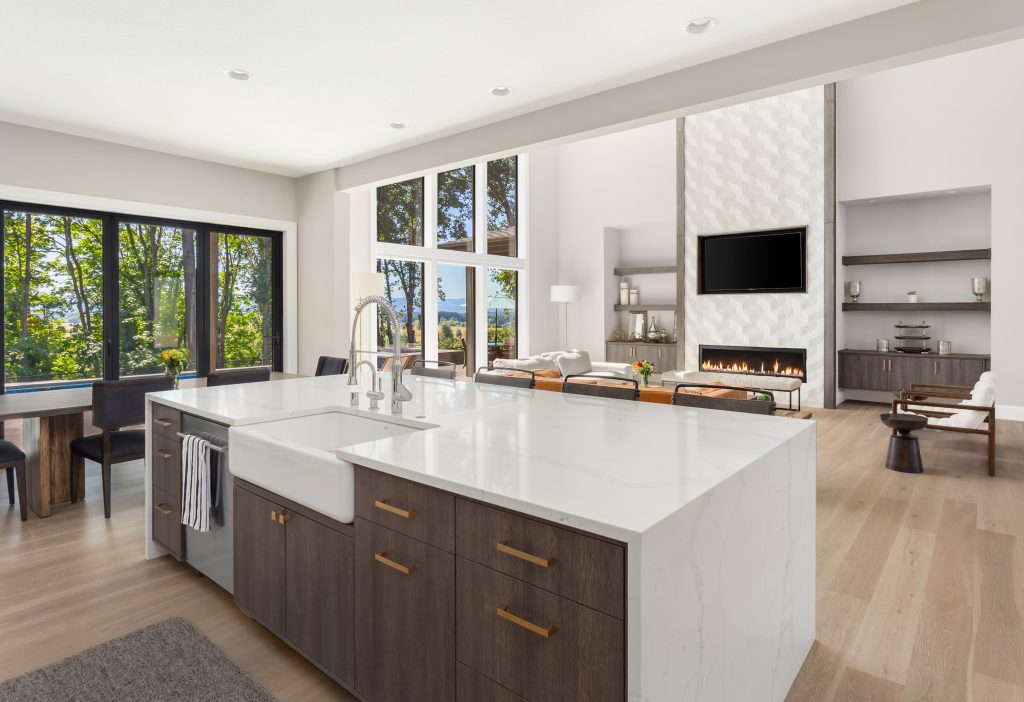
Does dramatic veining make a waterfall edge better?
Dramatic veining can make a waterfall edge exceptional, but only when the pattern is deliberately planned.
A bold vein that flows from the countertop down the side creates a strong visual effect. A vein that stops abruptly, changes direction, or fails to align can make the installation look pieced together.
Natural stone is irregular, so perfect continuity is not always possible. Still, slab layout can reduce awkward breaks and place the most attractive movement where it will be visible.
Quartz creates a different challenge. Some engineered patterns repeat, and a sharp graphic vein may reveal the corner joint more clearly than softer movement.
Viewing the full slab is essential. A small sample cannot show how the design will travel across the top and side panels.
What is the difference between a waterfall edge and a standard island?
A waterfall island uses vertical stone panels, while a standard island stops at the horizontal countertop edge.
The standard version exposes the cabinet sides. The waterfall version covers one or both ends with slab material.
| Feature | Standard island | Waterfall island |
|---|---|---|
| Material use | Lower | Higher |
| Fabrication complexity | Moderate | Higher |
| Visual weight | Lighter | Stronger |
| Cabinet visibility | Exposed | Partly concealed |
| Cost | Lower | Higher |
| Pattern planning | Important | Critical |
A standard island may be the better choice when the cabinetry is attractive and should remain visible. A waterfall works better when the goal is to make the stone the main visual feature.
Can a waterfall island make a small kitchen feel smaller?
Yes, a large stone-sided island can make a small kitchen feel visually heavier.
The vertical panels create a solid block that may reduce the sense of openness. Dark stone and high-contrast veining increase that effect.
Lighter stone, softer patterns, and a one-sided waterfall can reduce the visual weight. Another option is using a normal countertop edge with decorative cabinet panels below.
For smaller kitchen countertops in Hartwell, GA, we often recommend comparing several elevations before deciding. The island should fit the room rather than dominate it.
Is a one-sided waterfall better than two sides?
A one-sided waterfall can provide the visual effect with less cost and less visual weight.
This approach works well when one end of the island is highly visible from the living area or entry. The other end may include seating, storage, or an appliance that makes a stone panel less useful.
A one-sided design can also preserve cabinet detail while still creating a custom focal point. It is often a better compromise for transitional kitchens that are not fully minimalist.
The correct side should be selected based on sightlines, traffic, outlets, and seating.
How do waterfall edges affect island seating?
Waterfall panels can reduce knee space or limit seating at the island ends.
A standard overhang may allow stools along one side and occasionally around a corner. A full stone panel closes the end, which can make side seating less comfortable.
Before fabrication, the island layout should confirm:
- Number of stools
- Overhang depth
- Knee clearance
- Support requirements
- Outlet placement
- Walkway width
- Cabinet and appliance access
A beautiful island that is uncomfortable to use is not a successful design. Function needs to be settled before the stone layout is approved.
Are waterfall islands practical for family kitchens?
Yes, but edge exposure and daily traffic should be considered carefully.
Stone panels can protect cabinet sides from shoes, spills, and repeated contact. They are also easy to wipe compared with painted cabinet panels.
However, the outside corners remain vulnerable to impact. Children, stools, vacuum cleaners, and heavy objects can strike the edge. A precise mitered corner looks clean, but it still deserves reasonable care.
Granite and quartzite offer strong durability. Quartz is easy to clean but should be protected from excessive heat. Marble may develop chips, etching, or patina more readily.
How much does a waterfall island cost?
A waterfall island usually adds several thousand dollars to a countertop project because it requires extra slab material and more complex fabrication.
A single vertical panel may add approximately $1,000 to $3,000 or more. Two panels, rare material, pattern matching, difficult access, and oversized dimensions can raise the cost significantly.
| Material | Typical installed countertop range | Waterfall cost impact |
|---|---|---|
| Granite | $45–$120+ per sq. ft. | Moderate |
| Quartz | $55–$140+ per sq. ft. | Moderate |
| Marble | $70–$180+ per sq. ft. | High |
| Quartzite | $80–$200+ per sq. ft. | High |
Pricing depends on slab yield. The project may require an additional slab even when only part of it is used for the side panels.
At Anderson Granite & Marble Shop of Greenwood, we review the slab layout before giving a final project estimate because square footage alone does not show the true material requirement.
What fabrication details make a waterfall island look seamless?
Accurate templating, clean mitered joints, stable cabinets, and careful vein placement create the most seamless result.
The vertical panel usually meets the horizontal top at a mitered corner. Both pieces must be cut accurately so the joint remains tight and visually consistent.
The floor also matters. If the floor is uneven, the panel may need careful fitting. Cabinets must be level and secure before templating because movement can affect the corner alignment.
Important fabrication details include:
- Digital measurements
- Slab layout approval
- Pattern direction
- Mitered edge preparation
- Color-matched adhesive
- Floor scribing when needed
- Stable island anchoring
- Proper support during installation
A waterfall edge is less forgiving than a standard countertop. Small inaccuracies become visible across the full vertical face.
How long does a waterfall island take to fabricate?
Most waterfall projects take about 10–15 business days from final template to installation.
A standard countertop project often takes around 10–14 business days. Waterfall panels may require additional slab planning, miter fabrication, dry fitting, or installation coordination.
| Project stage | Typical timing |
|---|---|
| Material selection | 1–3 days |
| Digital templating | One appointment |
| Slab layout planning | 1–2 days |
| Fabrication | 7–12 business days |
| Installation | One day, sometimes longer |
| Plumbing reconnection | Same day or next day |
Complex patterns or difficult site access can extend the schedule. Homeowners selecting kitchen countertops in Hartwell, GA should finalize flooring, island cabinets, outlets, and appliance details before the template appointment.
Can an existing island be upgraded with waterfall panels?
Sometimes, but the existing countertop, cabinet dimensions, floor conditions, and slab availability must be evaluated first.
Adding panels later is more difficult than planning them with the original countertop. Matching an existing stone may be impossible because natural slabs vary and quartz production batches can differ.
The current overhang and edge may also prevent a clean miter connection. In many cases, the top must be replaced along with the side panels.
The island cabinet must also be stable enough to support the new material. A site evaluation is the safest way to determine whether the upgrade is practical.
Are there alternatives that look more current?
Yes, several alternatives create a custom island without covering both sides in stone.
A one-sided waterfall is one option. Others include wood end panels, fluted cabinet details, furniture-style legs, a thick mitered top, or a contrasting island material.
A standard stone top can still feel expensive when it has:
- A clean mitered edge
- Thoughtful overhang proportions
- Bookmatched or centered veining
- Well-designed cabinet panels
- Integrated lighting
- A contrasting but coordinated material
The island does not need stone on every side to feel finished.
Which kitchen styles still suit waterfall islands?
Modern, contemporary, and minimalist kitchens usually support waterfall islands most naturally.
Transitional kitchens can also use them when the stone and cabinetry are restrained. Traditional kitchens may benefit more from furniture-style island panels, posts, or decorative edges.
| Kitchen style | Waterfall compatibility | Best approach |
|---|---|---|
| Modern | Excellent | Clean two-sided waterfall |
| Contemporary | Excellent | Dramatic stone or contrast |
| Transitional | Good | One-sided or softer stone |
| Traditional | Moderate | Consider furniture-style panels |
| Rustic | Varies | Textured granite or quartzite |
The feature should support the architecture. It should not make the kitchen feel like it is copying a different design style.
What mistakes make waterfall islands look dated?
The biggest mistakes are using the feature without purpose, overloading the room with stone, and ignoring pattern continuity.
A waterfall edge begins to feel dated when it looks like a trend applied by default.
Common problems include:
- Two waterfall panels in a very small room
- Bold stone paired with a bold backsplash
- Poorly matched veins at the corners
- Insufficient seating clearance
- Visible outlets placed carelessly in the stone
- Heavy dark slabs in low-light kitchens
- Installing stone over an unstable island
- Using the same dramatic material everywhere
At Anderson Granite & Marble Shop of Greenwood, we prefer to simplify the design when extra material does not create a better result.
FAQ
Are waterfall islands outdated?
No. They still work well when the scale, stone, and kitchen style support the design.
Do waterfall countertops cost more?
Yes. They require extra material, mitered fabrication, pattern planning, and more complex installation.
Which stone is best for a waterfall island?
Granite, quartz, marble, and quartzite can all work, depending on budget, maintenance, and design goals.
Does a waterfall island require an extra slab?
Sometimes. The side panels may increase the project beyond the usable area of one slab.
Can waterfall edges chip?
Yes. Outside corners can chip if struck, although durable materials and careful use reduce the risk.
Is one waterfall side enough?
Yes. A one-sided waterfall can create a strong focal point with lower cost and less visual weight.
How long does fabrication take?
Most waterfall projects take about 10–15 business days after final templating.
Can waterfall panels be added later?
Sometimes, but matching the existing material and creating a clean connection can be difficult.
Planning a Waterfall Island in Hartwell, GA
Address: 3421 US-25 Greenwood, SC 29646
Phone: (864) 400-0150
Our suppliers: Cambria, MSI Surfaces, Daltile, Moda Quartz, Stone Showcase, Silestone (Cosentino House), Caesarstone, Hanstone, Walker Zanger, Spectrum Quartz, Wilsonart, Cosmos Surfaces.
A waterfall island is not overdone when it fits the room, supports the layout, and uses the stone intentionally. It becomes excessive when extra material replaces thoughtful design. The best decision may be a two-sided waterfall, one stone panel, or no waterfall at all.
Anderson Granite & Marble Shop of Greenwood is based in Greenwood, SC and serves Hartwell, GA and surrounding communities. We provide digital templating, custom fabrication, and professional installation for granite, quartz, marble, and quartzite kitchens, islands, bathrooms, vanities, backsplashes, and other residential stone projects.
For homeowners choosing kitchen countertops in Hartwell, GA, we help evaluate slab size, waterfall costs, pattern continuity, edge details, maintenance, seating, and installation requirements before fabrication begins.