

Yes, countertops can sometimes be installed before every appliance arrives, but only when final appliance specifications, cabinet dimensions, and required clearances are confirmed. The physical appliance does not always need to be in the kitchen, but accurate model information usually does.
The biggest risks involve slide-in ranges, cooktops, apron-front sinks, dishwashers, refrigerators with tight panels, and appliances that require countertop support or precise cutouts. If the measurements are wrong, the countertop may need expensive modification or replacement.
We explain this early to homeowners comparing granite countertop stores in Hartwell, GA because countertop fabrication is based on final dimensions. Once granite, quartz, marble, or quartzite is cut, there is limited room for adjustment.
At Anderson Granite & Marble Shop of Greenwood, we review appliance specifications before templating so fabrication can move forward without relying on guesses.
Do All Appliances Need to Be Installed Before Countertop Templating?
No, every appliance does not need to be physically installed, but all appliances that affect countertop dimensions must be selected and documented.
A freestanding refrigerator often has little effect on countertop fabrication. A cooktop, slide-in range, sink, or downdraft ventilation system is different because it may require a precise opening or specific spacing.
The safest approach is to have the actual appliance on-site. When that is not possible, we need the manufacturer’s installation guide, exact model number, cutout dimensions, and clearance requirements.
A general product width is not enough. Two appliances advertised as 30 inches wide may require different openings.
Which Appliances Must Be Selected Before Fabrication?
Cooktops, slide-in ranges, sinks, and certain ventilation systems should be selected before countertop fabrication begins.
These products directly affect cutouts, seams, overhangs, support, and cabinet spacing.
| Appliance or fixture | Must be selected before fabrication? | Why it matters |
|---|---|---|
| Cooktop | Yes | Requires an exact cutout |
| Slide-in range | Yes | Countertop edges must fit beside it |
| Drop-in range | Yes | May require support from the countertop |
| Apron-front sink | Yes | Cabinet and stone must coordinate |
| Undermount sink | Yes | Cutout is fabricated and polished |
| Dishwasher | Usually | Height and mounting method matter |
| Refrigerator | Usually not | No direct countertop cutout |
| Freestanding microwave | No | Usually sits on a finished surface |
For homeowners visiting granite countertop stores in Hartwell, GA, we recommend finalizing these items before the template appointment is scheduled.
Can a Cooktop Arrive After the Countertop Is Installed?
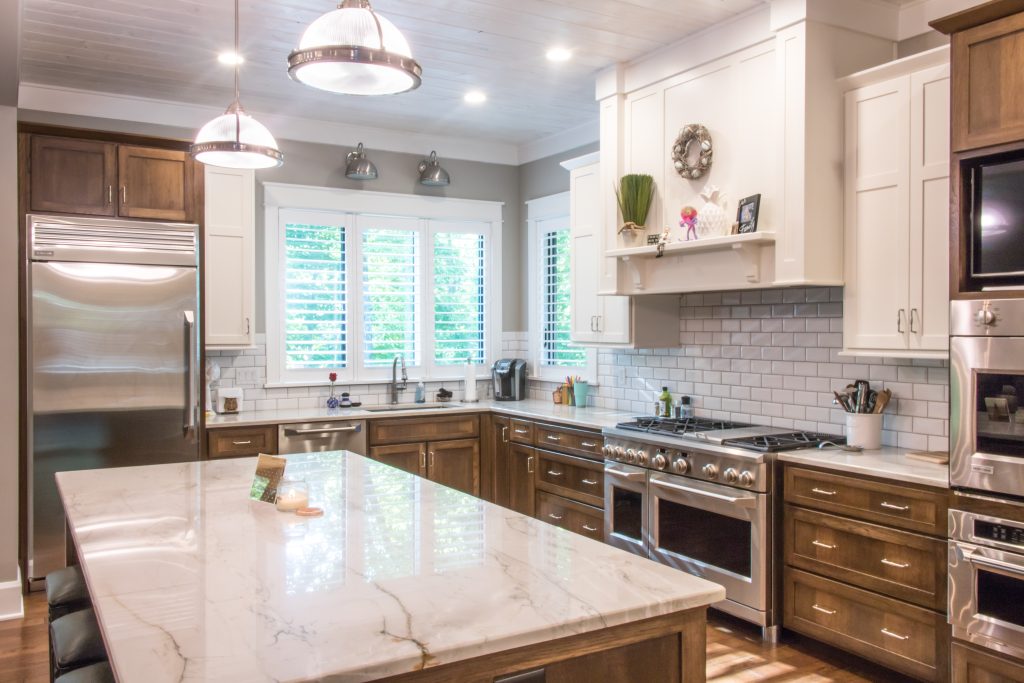
A cooktop may arrive later if the exact model and manufacturer-approved cutout dimensions are confirmed before fabrication.
We prefer having the cooktop available because we can verify the actual unit against the installation guide. Product dimensions can change between models, even within the same brand.
A cutout that is too small may sometimes be enlarged on-site, but that creates dust, noise, and additional risk. A cutout that is too large is much harder to correct because the missing stone cannot be added back.
The cooktop also needs enough clearance from seams, backsplashes, drawers, and cabinet walls. Ventilation requirements should be confirmed at the same time.
Can Countertops Be Installed Before a Slide-In Range Arrives?
They can, but installing without the actual range creates more risk than installing without a standard refrigerator.
A slide-in range fits between two countertop sections. The side gaps, countertop depth, finished edge position, and range height all affect the final appearance.
If the range is slightly wider than expected, it may not fit. If it is narrower, visible gaps may remain. The top of the appliance must also sit correctly relative to the countertop.
At Anderson Granite & Marble Shop of Greenwood, we recommend having the range on-site or obtaining complete installation specifications before the final template.
What Happens If the Dishwasher Has Not Arrived?
Countertops can usually be installed before the dishwasher arrives, provided the cabinet opening and finished floor height are correct.
The dishwasher normally slides beneath the countertop. The opening must be wide and tall enough after flooring and countertop installation.
Mounting method matters. Some dishwashers attach to the underside of wood or laminate counters, but stone cannot be drilled casually from below. Side-mount brackets or an approved mounting strip may be required.
An appliance can become trapped if flooring thickness, leveling feet, or countertop height is miscalculated. We therefore confirm the finished opening, not just the cabinet label.
Does the Refrigerator Need to Be in Place?
The refrigerator usually does not need to be installed before the countertops, but its dimensions still matter in tight layouts.
A freestanding refrigerator does not require a stone cutout. However, refrigerator panels, upper cabinets, side walls, and nearby countertop ends may leave limited clearance.
Built-in and counter-depth refrigerators require more planning. Door swing, handle clearance, ventilation space, and finished panel thickness can affect the adjoining countertop.
In a narrow kitchen, even a small measurement difference can cause the refrigerator door to strike an edge or prevent a drawer from opening fully.
Why Is the Sink More Important Than Most Appliances?
The sink is one of the most important items to have before fabrication because its shape controls the countertop opening and support plan.
An undermount sink requires a precisely cut and polished opening. The reveal—the amount of sink rim visible beneath the stone, should be decided before fabrication.
Apron-front sinks are even more demanding. The sink, cabinet, and countertop must align in height and width. Small differences can create visible gaps or leave weak stone rails.
The faucet, soap dispenser, filtered-water tap, and air switch should also be selected before drilling holes.
When planning projects through granite countertop stores in Hartwell, GA, homeowners should not assume that one sink model can be exchanged for another after the template is complete.
Can Temporary Appliance Measurements Be Used?
Temporary measurements should be avoided because product listings often omit installation details that affect the stone.
A retailer may list the overall appliance width, while the installation guide lists a different cabinet opening or countertop clearance. Online product pages can also contain errors or dimensions that exclude handles, trim, or ventilation space.
The correct source is the manufacturer’s technical document for the exact model number.
Before templating, we usually need:
- Exact model number
- Manufacturer installation guide
- Overall appliance dimensions
- Required opening dimensions
- Ventilation clearances
- Countertop overlap requirements
- Mounting instructions
- Electrical or gas connection locations
Guessing may save a few days initially but create weeks of delay later.
What Must Be Finished Before Countertop Templating?
Cabinets must be fully installed, level, secured, and in their final positions before the countertop is measured.
Countertops are fabricated to the cabinets, walls, and appliance openings as they exist during templating. Moving a cabinet afterward can make the finished stone too short, too long, or misaligned.
The following work should be complete:
- Base cabinets installed and secured
- Cabinets leveled across all runs
- End panels and fillers installed
- Island anchored in its permanent location
- Farmhouse sink installed when required
- Appliance models finalized
- Finished wall locations confirmed
- Support for overhangs planned
At Anderson Granite & Marble Shop of Greenwood, we do not recommend templating over temporary cabinets, loose islands, or incomplete appliance openings.
Can Countertops Be Installed Before the Flooring?
Sometimes, but the sequence depends on the cabinet and appliance plan.
If flooring will run beneath appliances but not beneath cabinets, the finished appliance height must still be calculated correctly. Dishwashers and slide-in ranges are especially sensitive to this sequence.
Installing thick flooring after the countertops can reduce the opening height beneath the stone. This may make it difficult to remove or replace an appliance later.
| Flooring sequence | Main advantage | Main risk |
|---|---|---|
| Flooring before cabinets | Continuous finished floor | Higher material use |
| Flooring after cabinets | Lower flooring cost | Appliance openings may tighten |
| Flooring before appliances | Correct finished appliance height | Schedule must be coordinated |
| Flooring after countertops | Countertops move sooner | Risk of trapped appliances |
The contractor, cabinet installer, flooring team, appliance installer, and fabricator should agree on the sequence before measurements are taken.
What Happens If an Appliance Model Changes After Templating?
Changing an appliance after templating can force a new measurement, delay fabrication, or make finished stone unusable.
If fabrication has not started, the template may be revised after the new specifications are reviewed. A second site visit may be needed.
If the countertop has already been cut, options are limited. A smaller cooktop opening may be enlarged if structural conditions allow. An oversized opening cannot be reduced easily.
A different range may create gaps, interfere with edges, or require cabinet changes. These corrections often cost more than waiting for the correct appliance information.
How Do Appliance Delays Affect the Countertop Timeline?
Appliance delays do not always stop the project, but missing specifications can prevent templating or fabrication from moving forward safely.
A typical stone project takes about 10–14 business days from final template to installation. That timeline begins only after the cabinets, sinks, and appliance details are ready.
| Project stage | Typical timing |
|---|---|
| Material selection | 1–5 days |
| Appliance specification review | 1–2 days |
| Digital templating | One appointment |
| Fabrication | 5–10 business days |
| Countertop installation | Usually one day |
| Appliance and plumbing connections | Same day or later |
Complex islands, full-height backsplashes, waterfall panels, and detailed pattern matching may add time.
For customers working with granite countertop stores in Hartwell, GA, ordering appliances early reduces the chance that one missing technical document will hold up the entire kitchen.
Do Granite, Quartz, Marble, and Quartzite Have Different Installation Risks?
The coordination requirements are similar, but the materials differ in how easily they can be modified after fabrication.
Granite and quartzite are hard and heat-resistant but can crack if altered carelessly around narrow cutouts. Marble is softer to machine but more vulnerable to scratching and chipping. Quartz is consistent but contains resin and requires appropriate tools and heat control.
| Material | On-site modification | Heat resistance | Typical maintenance |
|---|---|---|---|
| Granite | Limited | Excellent | Periodic sealing |
| Quartz | Limited | Moderate | No sealing |
| Marble | Possible but delicate | Good | Sealing and etch awareness |
| Quartzite | Difficult | Excellent | Periodic sealing |
The goal should not be to rely on on-site modification. Precise shop fabrication produces cleaner edges and reduces risk.
How Much Do New Countertops Cost?
Installed countertops generally range from about $45 to more than $200 per square foot, depending on the material and project details.
| Material | Typical installed price |
|---|---|
| Granite | $45–$120+ per sq. ft. |
| Quartz | $55–$140+ per sq. ft. |
| Marble | $70–$180+ per sq. ft. |
| Quartzite | $80–$200+ per sq. ft. |
Sink cutouts, cooktop openings, seams, specialty edges, backsplash pieces, removal of existing counters, and difficult access can increase the total.
At Anderson Granite & Marble Shop of Greenwood, we prepare estimates after reviewing the layout, slab, appliance openings, sink details, and installation conditions.
An incorrect appliance cutout can add several hundred dollars in modification costs or require replacement material. Confirming specifications before fabrication protects the larger investment.
What Is Included in Professional Countertop Installation?
Professional countertop service includes more than placing stone on cabinets.
A complete project may include:
- Material and finish consultation
- Digital templating
- Slab layout planning
- Sink and cooktop cutouts
- Faucet-hole drilling
- Edge fabrication
- Seam preparation
- Delivery and installation
- Sealing when needed
- Care instructions
Appliance connection, plumbing, electrical work, and gas connection are often completed by licensed trades after the countertop is installed. These responsibilities should be confirmed in the written project scope.
Can Full-Height Backsplashes Be Installed Before Appliances?
They can be fabricated before all appliances arrive, but range hoods, pot fillers, outlets, and cooktop positions must be finalized.
A slab backsplash is measured around fixed wall conditions. Moving an outlet or changing a hood after fabrication may leave visible holes or require a new piece.
In many projects, countertops are installed first and backsplash measurements are verified afterward. This two-step process improves accuracy where the wall meets the countertop.
What Should Homeowners Do If Appliances Are Backordered?
Homeowners should secure exact specifications and avoid substituting models without notifying the fabricator.
A useful approach is to:
- Confirm the model is still available
- Download and save the manufacturer’s installation guide
- Send the specifications before templating
- Verify the expected delivery date
- Identify a backup model with matching dimensions
- Notify the fabricator before making any substitution
A backup appliance should not be assumed compatible because it has the same advertised width.
What Mistakes Cause the Most Problems?
The most expensive mistakes involve late model changes, incomplete cabinets, guessed cutouts, and incorrect finished heights.
Common problems include:
- Templating before cabinets are level
- Ordering the sink after fabrication
- Changing from a freestanding to a slide-in range
- Using retail dimensions instead of installation dimensions
- Forgetting dishwasher mounting requirements
- Installing thick flooring after appliance openings are set
- Moving the island after templating
- Assuming all 30-inch cooktops use the same cutout
Good coordination prevents most of these problems.
FAQ
Can countertops be installed without the refrigerator?
Yes. A standard refrigerator usually does not affect countertop fabrication, although dimensions and door clearances should be confirmed.
Does the cooktop need to be on-site?
Preferably. If it is unavailable, the exact model number and manufacturer-approved cutout dimensions are required.
Can a dishwasher be installed after the countertop?
Yes, provided the finished opening height, width, and mounting method have been planned correctly.
Must the sink arrive before templating?
Yes, especially for undermount and apron-front sinks. The fabricator needs exact dimensions and cutout information.
What happens if the appliance model changes?
The template or fabricated countertop may need modification. Some changes can require a replacement piece.
Can countertops be installed before the range?
Sometimes, but slide-in and drop-in ranges require exact specifications and clearances.
How long does countertop fabrication take?
Most projects take about 10–14 business days from final templating to installation.
Who connects the appliances after installation?
Appliance, plumbing, electrical, and gas connections are typically completed by the appropriate licensed professionals.
About Anderson Granite & Marble Shop of Greenwood
Anderson Granite & Marble Shop of Greenwood is located at 3421 US-25, Greenwood, SC 29646. Homeowners can reach our team at (864) 400-0150.
We serve Greenwood, SC, Hartwell, GA, and nearby communities with countertop material selection, digital templating, slab layout planning, custom fabrication, sink and cooktop cutouts, edge finishing, delivery, and professional installation. We work with granite, quartz, marble, and quartzite for kitchens, islands, bathrooms, vanities, backsplashes, and other residential surfaces.
Our suppliers include Cambria, MSI Surfaces, Daltile, Moda Quartz, Stone Showcase, Silestone from Cosentino House, Caesarstone, Hanstone, Walker Zanger, Spectrum Quartz, Wilsonart, and Cosmos Surfaces.
For homeowners comparing granite countertop stores in Hartwell, GA, we help coordinate cabinet readiness, sinks, appliance specifications, fabrication details, pricing, and installation schedules so the countertop is cut correctly the first time.