
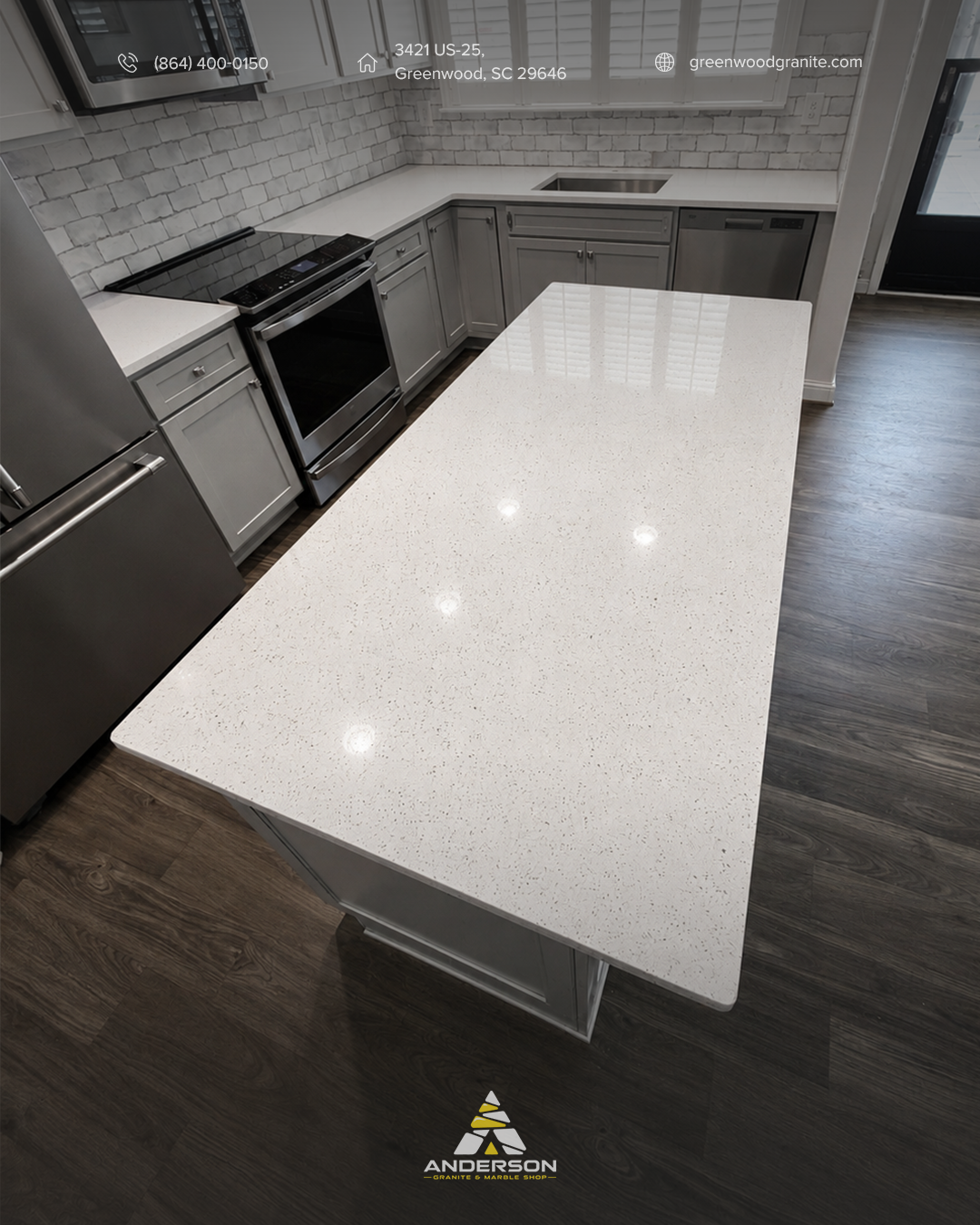
A countertop can feel perfect on installation day and still reveal annoyances a month later. The things homeowners remember are rarely the slab name; they are the seam they see every morning, the edge that catches crumbs, the finish that shows every streak, and the sink area that never seems fully dry.
For homeowners choosing kitchen countertops in Lincolnton, GA, the most important long-term detail is how the surface is finished and placed around daily-use zones. At Anderson Granite & Marble Shop of Greenwood, we look beyond the first impression and pay attention to edges, seams, overhangs, sink cutouts, backsplash lines, finish, and movement because those are the details people live with every day.
What Countertop Detail Do Homeowners Notice Most After Living With It?
The detail homeowners notice most is how the countertop behaves at the places they touch, wipe, and use constantly.
A beautiful slab can still frustrate a homeowner if a seam lands in the main sightline, the edge traps residue, or the faucet area feels crowded. These issues become more noticeable through daily use.
| Detail | Why it matters later | Common regret |
|---|---|---|
| Seam placement | Seen every day | “Why is it right there?” |
| Edge profile | Touched and wiped constantly | Crumbs or uncomfortable feel |
| Sink cutout | Main wet zone | Hard-to-clean corners |
| Overhang | Affects seating comfort | Knees hit cabinets |
| Finish | Controls glare and streaks | Surface always looks marked |
| Backsplash fit | Visible at eye level | Gaps or awkward transitions |
The best countertop is not only attractive. It should feel natural to use.

Why Do Seams Become More Noticeable Over Time?
Seams become more noticeable because homeowners learn exactly where they are and see them under different lighting conditions every day.
A seam that looked acceptable during installation may become more obvious under morning daylight, pendant lights, or under-cabinet LEDs. Strong veins, dark pigments, and reflective finishes can make the transition stand out more.
When we plan projects in Lincolnton, GA, we place seams where they make structural and visual sense. Corners or lower-visibility runs may work better than the visual center of a large island, depending on slab size and layout.
Why Does the Edge Profile Matter More Than People Expect?
The edge profile matters because it affects cleaning, comfort, appearance, and how heavy the countertop feels.
A simple eased edge is practical and easy to wipe. A pencil edge feels softer. A mitered edge can make an island look substantial, but it adds fabrication complexity and cost. Decorative profiles may collect more dust and residue.
| Edge type | Daily-use advantage | Watch for |
|---|---|---|
| Eased | Simple, easy to clean | Very minimal look |
| Pencil | Softer touch | Slightly more rounded |
| Small bevel | Adds definition | Must fit cabinet style |
| Mitered | Creates thicker appearance | Higher fabrication cost |
| Decorative | Traditional character | More detailed cleaning |
At Anderson Granite & Marble Shop of Greenwood, we treat the edge as a practical decision, not only a style choice.
Why Is the Sink Area the Real Test of a Countertop?
The sink area is the real test because it receives the most water, soap, food residue, hand traffic, and repeated wiping.
The sink wall reveals whether the layout is truly comfortable. Faucet holes need enough spacing, the cutout needs a smooth edge, and backsplash transitions should be clean.
A dark polished surface around the sink may show dried water spots quickly. A medium-movement granite or softly patterned quartz can make that same area feel easier to maintain.
Which Materials Feel Easier After Six Months of Real Use?
Quartz usually feels easiest for low-maintenance routines, while granite is often forgiving for cooking and heat. Quartzite offers strong natural movement and heat resistance, while marble requires the most acceptance of patina.
Quartz is non-porous and does not need sealing. Granite and quartzite usually need sealer checks over time. Marble can etch from lemon juice, vinegar, wine, tomato sauce, and some cleaners even when it has been sealed.
| Material | Daily-use strength | Heat resistance | Maintenance |
|---|---|---|---|
| Granite | Durable, forgiving movement | Excellent | Sealer checks |
| Quartz | Easy cleaning, no sealing | Moderate | Low |
| Marble | Soft character and patina | Good | Higher |
| Quartzite | Premium natural durability | Excellent | Sealer checks |
The right choice depends on cleaning habits, heat needs, and preferred appearance.
Why Does the Finish Change How Clean the Countertop Looks?
The finish changes how clean the countertop looks because it controls reflection, glare, fingerprint visibility, and how dried water marks appear.
Polished surfaces reflect the most light and are smooth to wipe. Honed surfaces reduce glare, but some darker honed stones can show oils more easily. Leathered granite can hide fingerprints and reflections, though the texture needs proper cleaning.
For kitchen countertops in Lincolnton, GA, we recommend looking at finish samples under both daylight and evening lighting before final approval.
How Much Movement Is Practical in a Busy Kitchen?
Soft to medium movement is usually the most practical because it adds depth while hiding small signs of daily life.
Very plain surfaces show crumbs, pepper, coffee drops, and shadows quickly. Extremely busy stone can hide mess, but it may make the room feel visually restless. Medium movement usually offers the most balanced result for families who cook often.
| Pattern level | Daily appearance | Best use |
|---|---|---|
| Very plain | Shows small marks | Minimal kitchens |
| Soft movement | Calm and forgiving | Most homes |
| Medium movement | Hides daily residue well | Family kitchens |
| Heavy movement | Dramatic | Large simple rooms |
| High contrast | Strong focal point | Feature islands |
A slab should still look good when the kitchen is being used, not only when it is empty.
How Much Do Kitchen Countertops Cost?
Installed stone countertops typically range from about $45 to $200+ per square foot, depending on material, slab selection, edge profile, finish, cutouts, backsplash work, delivery, sealing, and installation conditions.
Granite typically costs about $45-$120+ per square foot installed. Quartz is usually $55-$140+, marble $70-$180+, and quartzite $80-$200+.
| Material | Typical installed range | Long-term consideration |
|---|---|---|
| Granite | $45-$120+ per sq. ft. | Sealer checks |
| Quartz | $55-$140+ per sq. ft. | No sealing |
| Marble | $70-$180+ per sq. ft. | Etching and patina |
| Quartzite | $80-$200+ per sq. ft. | Premium material and sealing |
Homeowners pricing kitchen countertops in Lincolnton, GA should ask what the estimate actually includes. At Anderson Granite & Marble Shop of Greenwood, we review material, square footage, sink and cooktop cutouts, faucet holes, edge profile, seam placement, backsplash pieces, sealing, delivery access, and installation conditions before final pricing.
What Installation Details Matter Most After the Crew Leaves?
The details that matter most are fit, seam quality, cutout finish, overhang consistency, and backsplash alignment.
A countertop should sit securely and meet walls and cabinets cleanly. Island overhangs should feel comfortable for seating, and the faucet area should leave room for cleaning.
A complete countertop project may include:
- Material and finish consultation
- Digital templating
- Slab or remnant layout planning
- Seam and corner planning
- Sink, cooktop, and faucet cutouts
- Faucet-hole drilling
- Edge fabrication and polishing
- Backsplash or waterfall fabrication
- Sealing when natural stone requires it
- Delivery and professional installation
- Final care instructions
At Anderson Granite & Marble Shop of Greenwood, we review these details before fabrication because it is much easier to solve them on the plan than after installation.
How Long Does a Countertop Project Take?
Most countertop projects take about 10-14 business days from final templating to installation when material is available.
Material selection may take 1-5 days. Slab layout review can take 1-2 days when the stone has strong movement. Fabrication typically takes 5-10 business days, and many residential installations are completed in one day.
| Project stage | Typical timing |
|---|---|
| Material selection | 1-5 days |
| Digital templating | One appointment |
| Layout review | 1-2 days if needed |
| Fabrication | 5-10 business days |
| Installation | Usually one day |
Before templating kitchen countertops in Lincolnton, GA, cabinets should be installed, level, secured, and permanent. Sink, faucet, cooktop, appliances, overhangs, edge profile, backsplash direction, and waterfall details should also be final.
What Countertop Mistakes Do Homeowners Notice Only Later?
The biggest delayed regrets are poor seam placement, the wrong finish, an impractical edge, awkward overhangs, and choosing a material without understanding its care requirements.
They become frustrating because homeowners experience them repeatedly.
We recommend avoiding:
- Choosing the edge profile at the last minute
- Approving seams without reviewing sightlines
- Ignoring faucet and sink spacing
- Selecting polished dark stone without checking glare
- Choosing marble without accepting etching
- Picking a busy slab without a layout plan
- Reviewing price without checking included services
The best fabrication decisions disappear into daily life. The homeowner simply notices that the kitchen works.
What Should Homeowners Prioritize Before Final Approval?
Homeowners should prioritize daily-use details before decorative details.
We recommend confirming seam locations, edge profile, sink cutout, faucet-hole positions, overhang depth, backsplash plan, finish, and slab orientation before fabrication starts. These choices determine how the countertop feels long after the excitement of installation fades.
For homeowners selecting kitchen countertops in Lincolnton, GA, the goal should be a surface that is still comfortable after hundreds of meals, wipe-downs, grocery bags, and morning coffees.

FAQ
What countertop detail do homeowners regret most?
Poor seam placement, impractical edges, awkward sink layouts, and finishes that show every mark are common long-term frustrations.
What countertop material is easiest to maintain?
Quartz is usually easiest because it is non-porous and does not require sealing.
Is granite good for a busy kitchen?
Yes. Granite offers excellent heat resistance, natural durability, and patterns that can hide daily residue well.
Do countertop seams always show?
Most seams remain somewhat visible, but careful placement, color matching, and fabrication can make them less distracting.
How much do kitchen countertops cost?
Granite is commonly $45-$120+ per square foot installed, quartz $55-$140+, marble $70-$180+, and quartzite $80-$200+.
How long does countertop installation take?
Most projects take about 10-14 business days from final templating to installation when material is available.
What should be decided before templating?
Cabinets, sink, faucet, cooktop, appliances, edge profile, overhangs, backsplash direction, and waterfall plans should be final.
About Anderson Granite & Marble Shop of Greenwood
Our showroom is located at 3421 US-25 Greenwood, SC 29646. Homeowners can reach us at (864) 400-0150.
Our suppliers include Cambria, MSI Surfaces, Daltile, Moda Quartz, Stone Showcase, Silestone (Cosentino House), Caesarstone, Hanstone, Walker Zanger, Spectrum Quartz, Wilsonart, and Cosmos Surfaces.
From Greenwood, SC, we serve Lincolnton, GA and nearby communities with material selection, finish guidance, digital templating, slab and remnant layout planning, custom fabrication, sink and cooktop cutouts, faucet-hole drilling, edge finishing, seam planning, backsplash fabrication, sealing, delivery, and professional installation.
For homeowners choosing kitchen countertops in Lincolnton, GA, our team helps plan the details that matter after installation: seams, edges, sink areas, finishes, overhangs, pricing, fabrication, and installation timing.