
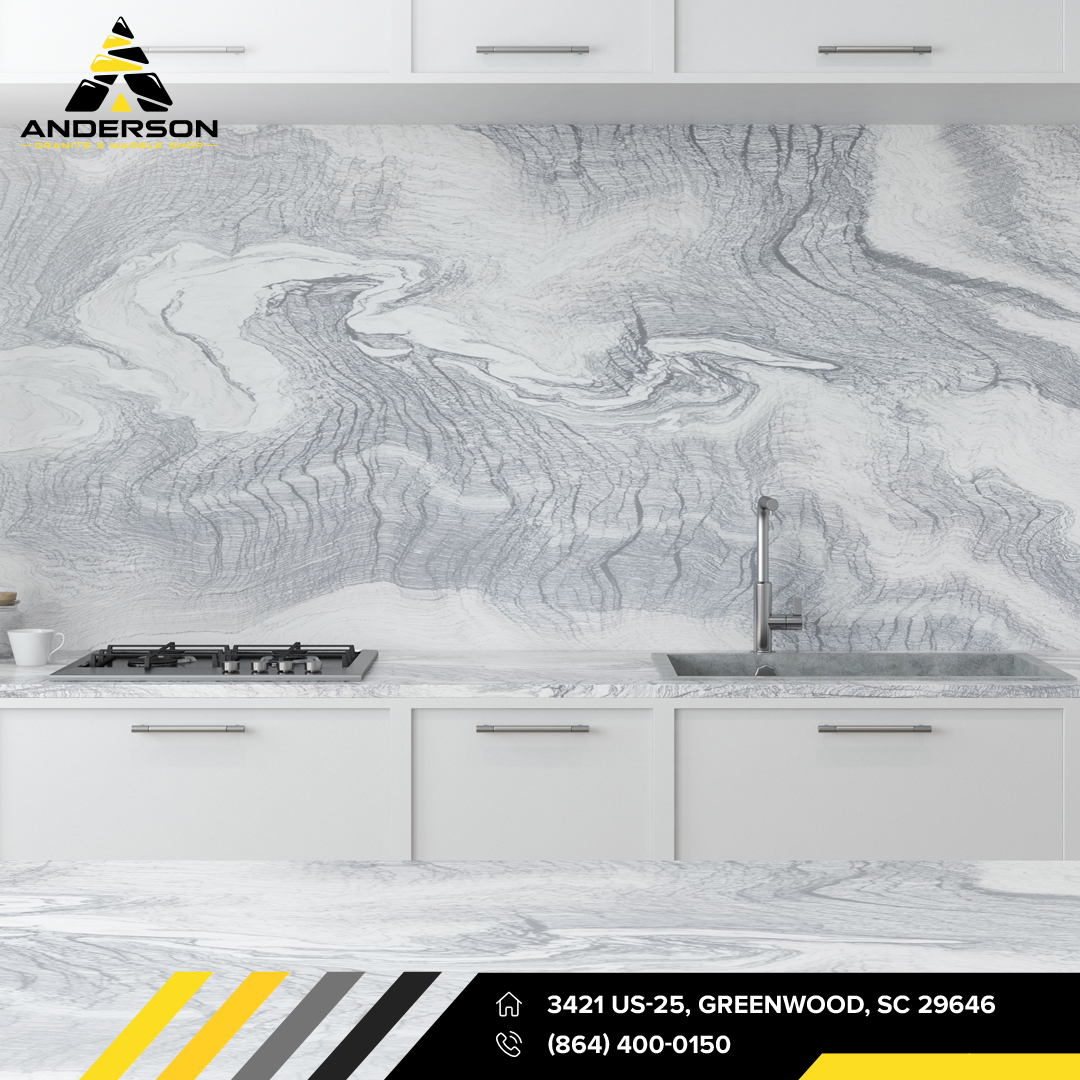
Etching on marble countertops is caused by acidic substances reacting with the calcium carbonate in the stone, which dulls or lightens the surface. We see this every week when working with homeowners considering or already using marble kitchen countertops in Silverstreet, SC. The confusion usually comes from mixing up etching with staining, they’re not the same thing.

What exactly is etching on marble?
Etching is a chemical reaction, not a stain. When something acidic touches marble, it reacts with the stone’s surface and changes its finish. The result is a dull spot, a light mark, or an area that looks less shiny than the rest. This is very different from a stain, which sits inside the stone. Etching happens on the surface itself. At Anderson Granite & Marble Shop of Greenwood, we explain this early because once you understand it, marble becomes much easier to live with.
What substances actually cause etching?
Common household acids are the main cause. The most frequent culprits include lemon juice, vinegar, wine, soda, and even some cleaning products. Toothpaste and skincare products can also cause mild etching in bathrooms. We’ve seen etching happen from something as simple as a drop of citrus left on the surface for a few minutes. It doesn’t take much. This is especially important for homeowners installing marble kitchen countertops in Silverstreet, SC, where cooking and food prep happen daily.
Why does marble react this way?
Marble is made of calcium carbonate, which is sensitive to acid. That’s the core reason. When acid touches marble, it breaks down the surface at a microscopic level. You don’t see damage like a crack, you see a change in texture and light reflection. Polished marble shows etching more clearly because of its reflective finish. Honed marble hides it better, but the reaction still happens. At Anderson Granite & Marble Shop of Greenwood, we often recommend honed finishes for clients who want a more forgiving look over time.
Can sealing marble prevent etching?
No, sealing does NOT prevent etching. This is one of the biggest misconceptions. Sealers protect against staining by slowing down liquid absorption. They do nothing against chemical reactions on the surface. We’ve had clients assume their sealed countertops were fully protected, only to notice dull spots later. Once we explain the difference, it makes sense. That’s why we always clarify this when installing marble kitchen countertops in Silverstreet, SC, so expectations match reality.
How quickly can etching happen?
Etching can happen almost instantly. In some cases, especially with strong acids like lemon juice or vinegar, the reaction starts within seconds. You may not notice it immediately, but once the surface dries, the mark becomes visible. We’ve seen situations where a quick splash during cooking led to a visible change in finish by the end of the day. That doesn’t mean marble is fragile, it means it’s reactive.
Is etching permanent?
Etching is not permanent, but it’s not removable with regular cleaning. You can’t wipe it away because it’s not a surface residue. However, it can be repaired. Light etching can sometimes be buffed out with polishing compounds. Deeper etching may require professional refinishing. At Anderson Granite & Marble Shop of Greenwood, we often guide homeowners through restoration options. Most surfaces can be brought back to their original finish if needed.
Does etching get worse over time?
Yes, but it often becomes less noticeable. This might sound surprising, but as more etching occurs over time, it blends into the overall surface. Instead of seeing individual marks, the countertop develops a softer, more uniform patina. We’ve had clients who initially worried about every spot, then stopped noticing them completely after a few months. That’s a common experience with marble kitchen countertops in Silverstreet, SC, especially in active kitchens.

How do real homeowners deal with etching?
Most adjust their expectations, not their lifestyle. At first, people tend to be very careful. They wipe everything immediately, avoid certain products, and monitor the surface closely. Then gradually, they relax. The countertop becomes part of daily life instead of something to manage. Small marks stop feeling like problems. At Anderson Granite & Marble Shop of Greenwood, we’ve seen this shift happen consistently. It’s less about preventing every etch and more about understanding the material.
How can you reduce etching in everyday use?
You can’t eliminate it, but you can minimize it. Using cutting boards, wiping acidic spills quickly, and avoiding harsh cleaners all help. Choosing a honed finish also makes etching less visible. But the key is balance. We don’t recommend changing your entire routine just to protect the surface. The goal is to make marble work with your lifestyle, not against it. That’s something we emphasize with every client installing marble kitchen countertops in Silverstreet, SC.
How does marble compare to other materials?
Marble is more reactive than granite and quartz. Granite handles acids better and is less prone to etching. Quartz is non-reactive and doesn’t etch at all. But marble offers a look and feel that those materials don’t replicate. It’s softer, more natural, more dynamic. We always present this as a trade-off, not a flaw. At Anderson Granite & Marble Shop of Greenwood, we help clients decide based on how they use their kitchen, not just how they want it to look.
What does marble cost and how long does installation take?
Marble countertops typically cost $60–$120 per square foot installed. For a standard kitchen (around 40 sq ft), that puts the total between $2,400 and $4,800 depending on the slab, edge profile, and fabrication details. The full process, from template to installation, usually takes 10–14 days. At Anderson Granite & Marble Shop of Greenwood, we handle templating, fabrication, edge finishing, sink cutouts, and installation as part of the process for homeowners in Silverstreet, SC and surrounding areas.
FAQ: Marble Etching Explained Simply
What is the main cause of etching on marble? Acidic substances reacting with the stone’s calcium content.
Can I prevent etching completely? No. You can reduce it, but not eliminate it entirely.
Does sealing marble stop etching? No. Sealing only helps with stains, not surface reactions.
How do I fix etched marble? Light etching can be polished; deeper marks may need professional refinishing.
Is marble a bad choice for kitchens? No. It just requires understanding and realistic expectations.
Does honed marble etch less? It etches the same, but marks are less visible.
How quickly should I clean spills? As soon as possible, especially acidic liquids.
Etching is not damage in the traditional sense. It’s part of how marble interacts with real life. Once you understand what causes it, it stops being confusing. And once expectations are clear, the material becomes much easier to live with. For many homeowners, that trade-off is worth it.
About Anderson Granite & Marble Shop of Greenwood
At Anderson Granite & Marble Shop of Greenwood, we work with homeowners throughout Greenwood, SC and serve Silverstreet, SC with full-service countertop solutions. We handle everything from material selection to fabrication and installation, including granite, quartz, and marble surfaces. If you’re considering marble kitchen countertops in Silverstreet, SC, we can walk you through the process, explain how the material behaves, and help you choose what fits your real lifestyle, not just the showroom version. Because the right countertop isn’t just about how it looks. It’s about how it works every single day.