

A small island can feel surprisingly heavy when the stone on top is doing too much. Dark color, tight speckling, thick edges, and aggressive movement can make a compact island look shorter and bulkier even when its dimensions are practical.
For homeowners choosing custom granite countertops in Lincolnton, GA, we usually look for granite that creates visual breathing room instead of turning every square inch into a focal point. At Anderson Granite & Marble Shop of Greenwood, we pay attention to color, pattern scale, finish, edge profile, overhang, and the view from the doorway because those details decide whether a small island feels open or crowded.
What Granite Makes a Small Island Feel Bigger?
Light to medium granite with soft or broad movement usually makes a small island feel bigger.
Warm white, cream, light greige, pale gray, and beige-gray granite reflect more available light and keep the countertop from reading like a dark block in the center of the room. We also prefer movement large enough to read as one continuous surface rather than dozens of tiny marks.
| Granite feature | Effect on a small island | Better choice |
|---|---|---|
| Light or mid-light base | Reduces visual weight | Warm white, cream, greige |
| Broad movement | Makes the top read as one surface | Soft mineral movement |
| Low to medium contrast | Keeps edges from feeling harsh | Balanced neutral pattern |
| Simple edge | Makes the slab look thinner | Eased or pencil edge |
| Controlled sheen | Adds light without excessive glare | Polished or satin |
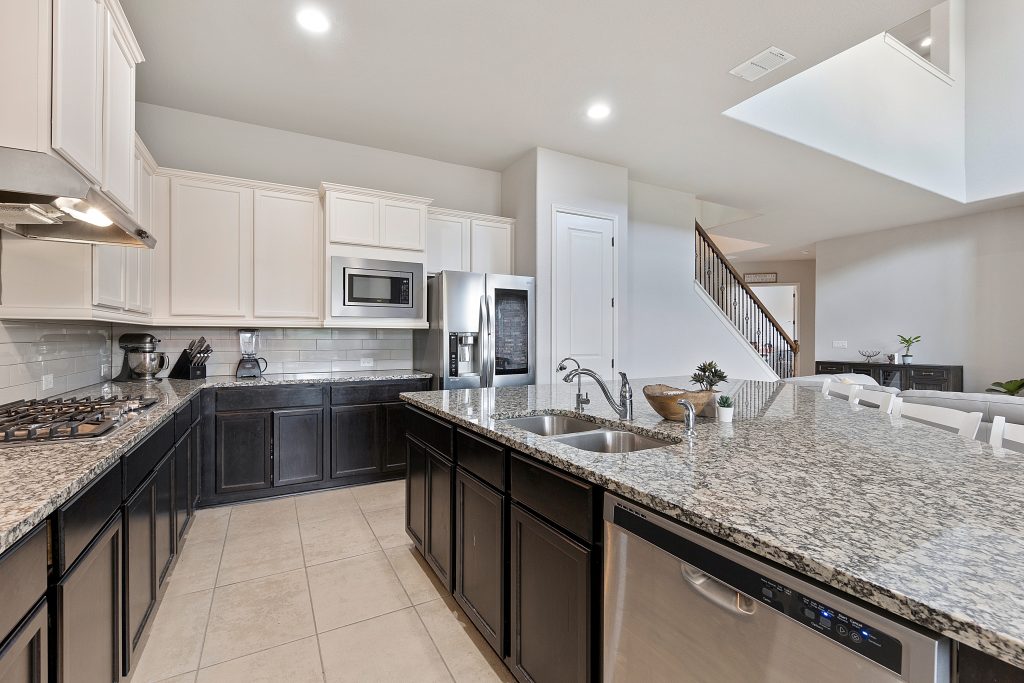
Why Can Dark Granite Make a Small Island Feel Smaller?
Dark granite can make a small island feel smaller because it increases visual mass, especially when the cabinetry underneath is also dark.
Black, deep brown, or charcoal granite can look beautiful, but a compact island with dark cabinets and a thick edge may read as one solid block. In a kitchen with limited daylight, that effect becomes stronger.
When we help clients review custom granite countertops in Lincolnton, GA, we do not automatically eliminate dark stone. We check whether light flooring, pale perimeter cabinets, open sightlines, or strong natural light can balance it.
Does Granite Pattern Size Change How Large an Island Looks?
Yes. Pattern scale can make a small island look broader or more crowded.
Very tight speckling creates many small visual stops. Extremely dramatic movement can also overwhelm a short surface because the pattern does not have enough room to develop. Soft, medium-to-broad movement usually gives us the best balance.
| Pattern type | How it reads on a small island | Visual result |
|---|---|---|
| Fine dense speckling | Many small details | Can feel busy |
| Soft mineral movement | Continuous surface | More open |
| Medium movement | Adds depth without crowding | Balanced |
| Very bold veining | Pattern may feel cut off | Can shrink the surface |
| High-contrast clusters | Separates the top visually | More fragmented |
At Anderson Granite & Marble Shop of Greenwood, we like to view the slab from several feet away before final layout. The island will usually be seen from across the kitchen, not only from directly above.
Which Granite Colors Work Best With White or Wood Island Cabinets?
Warm gray, cream, pale taupe, greige, and light granite with subtle darker minerals usually work well with both white and natural wood islands.
With white cabinetry, a little soft contrast defines the top without making it heavy. With white oak, walnut, or stained wood, a lighter granite balances the cabinet grain instead of adding another strong pattern.
Does the Edge Profile Make a Small Island Look Bigger?
Yes. A simple edge can make the island look lighter and less bulky.
Thick laminated edges and elaborate profiles create a stronger horizontal band around the top. On a compact island, that band can make the countertop feel oversized.
For custom granite countertops in Lincolnton, GA, we often recommend an eased edge, pencil edge, or small bevel when the goal is visual openness. These profiles are also practical because they are easy to wipe and do not trap residue in deep decorative grooves.
Which Finish Helps a Small Island Feel More Open?
A polished or satin finish often helps because it reflects light and surrounding colors.
Polished granite can brighten a dim kitchen, while satin gives a softer reflection. Leathered granite reduces glare and feels more grounded, which can work when the room already has plenty of natural light.
How Do Granite, Quartz, Marble, and Quartzite Affect a Small Island Differently?
Granite gives natural mineral depth, quartz offers controlled pattern, marble creates soft movement, and quartzite can introduce larger natural veining.
Quartz is non-porous and does not require sealing. Granite and quartzite offer excellent heat resistance and generally need periodic sealer checks. Marble has a softer appearance but can etch from lemon juice, vinegar, wine, tomato sauce, and some cleaners.
| Material | Visual character | Heat resistance | Maintenance | Small-island advantage |
|---|---|---|---|---|
| Granite | Natural mineral movement | Excellent | Moderate | Forgiving depth |
| Quartz | Controlled and consistent | Moderate | Low | Easy to keep visually quiet |
| Marble | Soft natural veining | Good | Higher | Light, elegant appearance |
| Quartzite | Strong natural movement | Excellent | Moderate | Premium focal point |
At Anderson Granite & Marble Shop of Greenwood, we sometimes recommend quartz when the homeowner wants an especially quiet island. The right material depends on the visual goal and daily use.
How Much Do Granite Countertops Cost?
Granite typically costs about $45-$120+ per square foot installed, depending on slab selection, finish, edge profile, cutouts, backsplash work, sealing, delivery, and installation conditions.
Quartz usually ranges from $55-$140+ per square foot installed. Marble commonly ranges from $70-$180+, while quartzite often ranges from $80-$200+.
| Material | Typical installed range | Main small-island cost factor |
|---|---|---|
| Granite | $45-$120+ per sq. ft. | Slab or remnant selection |
| Quartz | $55-$140+ per sq. ft. | Brand and pattern |
| Marble | $70-$180+ per sq. ft. | Finish and slab grade |
| Quartzite | $80-$200+ per sq. ft. | Slab rarity and fabrication |
Homeowners pricing custom granite countertops in Lincolnton, GA should ask whether digital templating, fabrication, faucet-hole drilling, cutouts, edge finishing, sealing, delivery, and installation are included. For a smaller island, a suitable remnant may sometimes reduce material cost, depending on dimensions and inventory.
Do Overhang and Seam Placement Affect Visual Size?
Yes. A balanced overhang keeps the island useful without letting the top visually swallow the cabinet base, while unnecessary seams can break the surface into smaller-looking sections.
We plan overhang around seating, support requirements, traffic flow, and the island’s purpose. Many small islands can often be fabricated as one piece depending on slab size and layout, but when a seam is required, we try to keep it away from the strongest movement.
What Fabrication Details Make a Small Island Look More Refined?
Accurate templating, clean edges, balanced overhangs, careful slab layout, and precise cutouts make the biggest difference.
A complete granite project may include:
- Material and finish consultation
- Digital templating
- Slab or remnant layout planning
- Sink or cooktop cutouts when needed
- Faucet-hole drilling
- Edge fabrication and polishing
- Seam and corner planning
- Sealing when appropriate
- Delivery and professional installation
At Anderson Granite & Marble Shop of Greenwood, we review these details before cutting because a visually light island depends as much on proportion and fabrication as it does on stone color.
How Long Does a Granite Island Project Take?
Most granite countertop projects take about 10-14 business days from final templating to installation when the selected material is available.
Material selection may take 1-5 days. Layout review can take 1-2 days when needed. Fabrication typically takes 5-10 business days, and installation is often completed in one day.
| Project stage | Typical timing |
|---|---|
| Material selection | 1-5 days |
| Digital templating | One appointment |
| Layout review | 1-2 days if needed |
| Fabrication | 5-10 business days |
| Installation | Usually one day |
Before templating in Lincolnton, GA, the island cabinets should be installed, level, secured, and permanent. Sink, faucet, cooktop, seating overhang, edge profile, and support requirements should also be finalized.
What Mistakes Make a Small Island Feel Even Smaller?
The biggest mistakes are using too much contrast, too much pattern, or too much visual thickness.
We recommend avoiding:
- Very dark granite over equally dark cabinets in a dim room
- Tight, busy patterns that fragment the top
- Oversized decorative edges
- An overhang that is visually too large for the base
- Strong floor and backsplash patterns competing with the island
- Choosing from a tiny sample without checking full-scale movement
What Is the Best Final Granite Choice for a Small Island?
The best choice is usually light to medium granite with soft or medium movement, low-to-moderate contrast, and a simple edge.
Warm white, cream, greige, pale gray, and beige-gray are reliable starting points. We then adjust the undertone to the flooring, cabinets, lighting, and nearby finishes.
For homeowners choosing custom granite countertops in Lincolnton, GA, the goal is not to make the island disappear. We want it to feel visually lighter, proportionate, and large enough to be useful without making the kitchen feel crowded.

FAQ
What granite color makes a small island look bigger?
Warm white, cream, light greige, beige-gray, and pale gray granite usually make a compact island feel lighter and more open.
Is dark granite bad for a small island?
No. It simply adds more visual weight and works best when the room has enough light and contrast to balance it.
What edge is best for a small granite island?
An eased edge, pencil edge, or small bevel usually looks lighter than a thick decorative profile.
Can a small island use a granite remnant?
Sometimes. If a remnant is large enough and suits the layout, it can be a practical material option.
How much does granite cost?
Granite generally costs about $45-$120+ per square foot installed, depending on slab, finish, edge, cutouts, sealing, and site conditions.
How long does granite installation take?
Most projects take about 10-14 business days from final templating to installation when material is available.
About Anderson Granite & Marble Shop of Greenwood
Our showroom is located at 3421 US-25 Greenwood, SC 29646. Homeowners can reach us at (864) 400-0150.
Our suppliers include Cambria, MSI Surfaces, Daltile, Moda Quartz, Stone Showcase, Silestone (Cosentino House), Caesarstone, Hanstone, Walker Zanger, Spectrum Quartz, Wilsonart, and Cosmos Surfaces.
From Greenwood, SC, we serve Lincolnton, GA and nearby communities with material selection, digital templating, slab and remnant layout planning, custom fabrication, sink and cooktop cutouts, faucet-hole drilling, edge finishing, seam planning, backsplash and waterfall fabrication, sealing, delivery, and professional installation. We work with granite, quartz, marble, and quartzite for kitchens, islands, bathrooms, vanities, and other residential surfaces.
For homeowners planning custom granite countertops in Lincolnton, GA, we help balance color, movement, finish, edge profile, overhang, lighting, pricing, and fabrication so even a compact island feels open, useful, and properly scaled to the kitchen.