
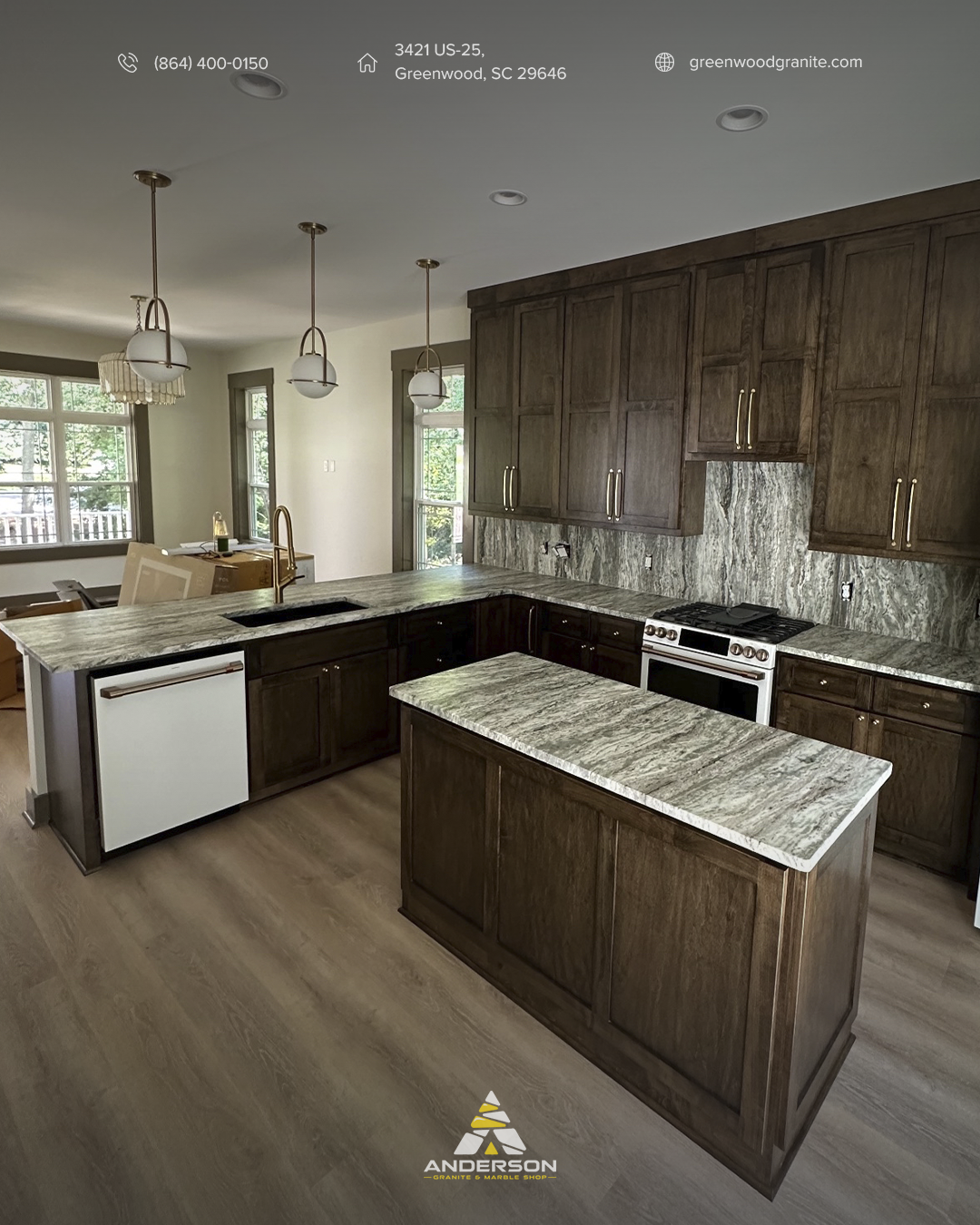
Marble should not turn dinner into a list of things nobody is allowed to touch. If a homeowner loves natural stone but does not want to panic over every coffee cup, lemon wedge, or serving platter, the answer is not “indestructible marble.” The answer is choosing the right finish and accepting how the surface will age.
For homeowners considering marble kitchen countertops in Lincolnton, GA, we usually recommend honed, softly patterned marble over highly polished stone when daily use matters. At Anderson Granite & Marble Shop of Greenwood, we talk about cooking habits before slab beauty because a countertop has to work on ordinary weekdays, not only look perfect on installation day.
What Marble Works Best If You Don’t Want to Baby Your Kitchen?
Honed marble with moderate movement and a forgiving background usually works best for homeowners who want marble without constantly worrying about it.
A honed finish is matte rather than highly reflective, so small etches and light wear blend in more easily. Cream, warm white, and softly veined marbles can feel calmer than bright polished stone.
| Marble choice | Why it is easier to live with | What to expect |
|---|---|---|
| Honed finish | Etching blends into the matte surface | Patina still develops |
| Soft movement | Small marks are less isolated | Natural variation remains |
| Warm white or cream base | Less harsh than bright polished white | Needs stone-safe care |
| Moderate veining | Keeps the kitchen calm | Layout still matters |
| Simple eased edge | Easier to wipe | Less decorative detail |
There is no maintenance-free marble. We aim for marble that ages in a way the homeowner can enjoy.

Why Is Honed Marble Easier Than Polished Marble?
Honed marble is usually easier because the finish already has a soft, low-sheen appearance.
Polished marble reflects light strongly. When lemon juice, wine, vinegar, tomato sauce, or another acid touches it, the resulting etch can look like a dull patch against the surrounding shine. On honed marble, that contrast is usually less dramatic.
| Finish | Etching visibility | Scratch visibility | Daily feel |
|---|---|---|---|
| Polished | High | Moderate to high | Formal and glossy |
| Honed | Lower | Lower | Relaxed and lived-in |
| Brushed | Lower | Lower | Textured and casual |
At Anderson Granite & Marble Shop of Greenwood, we often explain that finish can matter as much as color.
Does Sealing Make Marble Low-Maintenance?
No. Sealing helps reduce staining, but it does not stop etching, scratching, or normal patina.
A sealer slows the absorption of liquids such as oil or wine. It does not create an acid-proof coating. Etching happens because acids react with calcite in marble, and that reaction can occur even on properly sealed stone.
Which Marble Colors Hide Everyday Wear Best?
Soft white, creamy white, gray-white, and moderately veined marble usually hide everyday wear better than highly uniform stone.
The more visually perfect and reflective the surface looks on day one, the more noticeable the first mark may feel. Gentle veining gives the eye natural variation, so a tiny scratch or dull spot does not sit alone on an otherwise blank field.
Strong dramatic veins can still work, but we plan where major movement lands around sinks, seams, edges, and waterfall panels.
What Daily Habits Make Marble Easier to Live With?
Simple habits make marble much easier to live with without turning the kitchen into a museum.
We recommend:
- Using cutting boards for citrus, tomatoes, and food preparation
- Wiping wine, coffee, sauces, and oils reasonably quickly
- Using mild soap or a stone-safe cleaner
- Avoiding vinegar, citrus cleaner, bleach, and abrasive pads
- Lifting heavy ceramic pieces instead of dragging them
These are practical habits, not emergency rules.
Is Marble a Good Choice for People Who Cook Every Day?
Yes, marble can work for people who cook every day if they accept natural wear.
A homeowner who sees patina as character can enjoy marble for decades. Someone who wants every square inch to remain visually identical may be happier with quartz, granite, or quartzite.
When clients ask us about marble kitchen countertops in Lincolnton, GA, we talk about tolerance for change before discussing color.
Should Marble Be Used Everywhere in the Kitchen?
Not necessarily. Using marble selectively can give homeowners the look they love while reducing maintenance in the busiest zones.
Marble may work beautifully on a baking station, lower-use perimeter, or decorative backsplash while granite, quartz, or quartzite handles the main prep island.
| Kitchen zone | Marble suitability | Why |
|---|---|---|
| Baking station | Good | Marble stays naturally cool |
| Low-use perimeter | Good | Less heavy prep |
| Coffee bar | Moderate | Spills need quick cleanup |
| Main prep island | Lifestyle-dependent | Frequent acid and food exposure |
| Decorative backsplash | Good | Low direct wear |
We do not believe every countertop in one kitchen has to be the same material.
How Does Marble Compare With Granite, Quartz, and Quartzite?
Marble needs the most acceptance of visible aging, while quartz is usually lowest-maintenance and granite and quartzite offer stronger heat resistance.
Quartz is non-porous and does not require sealing. Granite has excellent heat resistance and natural movement. Quartzite also offers excellent heat resistance and can provide marble-like drama, although it typically costs more and needs sealer checks.
| Material | Heat resistance | Stain resistance | Etching risk | Maintenance |
|---|---|---|---|---|
| Marble | Good | Moderate with sealing | High | Higher |
| Granite | Excellent | Good with sealing | Low | Moderate |
| Quartz | Moderate | High | Low | Low |
| Quartzite | Excellent | Good with sealing | Low | Moderate |
At Anderson Granite & Marble Shop of Greenwood, we sometimes recommend a different material after learning how a household actually uses the kitchen.
How Much Do Marble Countertops Cost?
Marble usually costs about $70-$180+ per square foot installed, depending on slab selection, finish, edge profile, square footage, sink and cooktop cutouts, backsplash, sealing, delivery, and installation conditions.
Granite usually ranges from $45-$120+ per square foot installed. Quartz commonly ranges from $55-$140+, while quartzite often ranges from $80-$200+.
| Material | Typical installed range | Best fit |
|---|---|---|
| Granite | $45-$120+ per sq. ft. | Busy kitchens needing heat resistance |
| Quartz | $55-$140+ per sq. ft. | Low-maintenance households |
| Marble | $70-$180+ per sq. ft. | Homeowners comfortable with patina |
| Quartzite | $80-$200+ per sq. ft. | Premium natural-stone kitchens |
Homeowners pricing marble kitchen countertops in Lincolnton, GA should ask what the estimate includes. At Anderson Granite & Marble Shop of Greenwood, we review the slab, finish, digital template, cutouts, faucet holes, edge profile, seam locations, backsplash pieces, sealing, delivery access, and installation conditions before final pricing.
What Fabrication Details Make Marble Easier to Own?
Good fabrication makes marble easier to own because careful layout, clean cutouts, practical edges, and thoughtful seams reduce daily frustration.
A decorative edge can collect residue. An awkward seam can interrupt a strong vein. A poorly planned sink area can create difficult-to-clean corners.
A complete marble project may include:
- Material and finish consultation
- Digital templating
- Full-slab layout planning
- Sink, cooktop, and faucet cutouts
- Edge fabrication and polishing
- Seam and corner planning
- Backsplash or waterfall fabrication
- Sealing when appropriate
- Delivery and professional installation
How Long Does a Marble Countertop Project Take?
Most marble countertop projects take about 10-14 business days from final templating to installation when material is available.
Material selection can take 1-5 days. Layout review may take 1-2 days when the marble has strong veining. Fabrication typically takes 5-10 business days, and installation is often completed in one day.
| Project stage | Typical timing |
|---|---|
| Marble selection | 1-5 days |
| Digital templating | One appointment |
| Slab layout review | 1-2 days if needed |
| Fabrication | 5-10 business days |
| Installation | Usually one day |
Before templating marble kitchen countertops in Lincolnton, GA, cabinets should be installed, level, secured, and permanent. Sink, faucet, cooktop, appliances, overhangs, edge profile, backsplash direction, and waterfall details should also be finalized.
What Marble Mistakes Create the Most Maintenance Stress?
The biggest mistake is choosing marble for its showroom appearance while expecting it to behave like quartz.
Another common mistake is selecting a polished finish even though the homeowner knows dull spots will bother them. Harsh cleaners, direct cutting, and unrealistic expectations make the problem worse.
We recommend avoiding:
- Assuming sealer prevents etching
- Using vinegar or citrus-based cleaners
- Choosing polished marble if every dull mark will cause stress
- Selecting dramatic stone without reviewing full-slab layout
- Dragging ceramic or metal items across the counter
A countertop should support the household, not force the household to change every routine.
What Is the Best Marble for a Relaxed Kitchen?
The best marble for a relaxed kitchen is usually honed, softly veined, and selected with patina in mind.
We prefer marble that has enough natural movement to make small changes feel part of the surface rather than obvious defects. Simple edges and practical layouts also help.
For homeowners choosing marble kitchen countertops in Lincolnton, GA, the real goal is not finding marble that never changes. It is finding marble whose changes will not make the homeowner regret using the kitchen.
FAQ
What marble is easiest to maintain in a kitchen?
Honed marble with soft to moderate veining is often easier to live with because etches and light wear blend into the matte finish better.
Does honed marble still etch?
Yes. Honing reduces the visual contrast of etching but does not prevent the chemical reaction.
Can sealing make marble stain-proof?
No. Sealing helps slow absorption and reduce staining risk, but it does not make marble stain-proof or etch-proof.
Is marble good for a busy family kitchen?
It can be if the household accepts patina and follows basic stone-safe cleaning habits. Otherwise, granite, quartz, or quartzite may be less stressful.
How much does marble cost?
Marble generally costs about $70-$180+ per square foot installed, depending on slab, finish, edge, cutouts, backsplash work, and installation conditions.
How long does marble installation take?
Most projects take about 10-14 business days from final templating to installation when material is available.
Is quartzite easier to maintain than marble?
Generally, yes. Quartzite has excellent heat resistance and is less vulnerable to acid etching, although it still requires appropriate sealing and care.
About Anderson Granite & Marble Shop of Greenwood
Our showroom is located at 3421 US-25 Greenwood, SC 29646. Homeowners can reach us at (864) 400-0150.
Our suppliers include Cambria, MSI Surfaces, Daltile, Moda Quartz, Stone Showcase, Silestone (Cosentino House), Caesarstone, Hanstone, Walker Zanger, Spectrum Quartz, Wilsonart, and Cosmos Surfaces.
From Greenwood, SC, we serve Lincolnton, GA and nearby communities with marble, granite, quartz, and quartzite selection, digital templating, slab and remnant layout planning, custom fabrication, sink and cooktop cutouts, faucet-hole drilling, edge finishing, backsplash and waterfall fabrication, sealing, delivery, and professional installation.
For homeowners researching marble kitchen countertops in Lincolnton, GA, we help choose the right finish, slab movement, layout, pricing, fabrication plan, and care expectations so marble can feel like part of a working kitchen instead of a surface everyone is afraid to touch.