
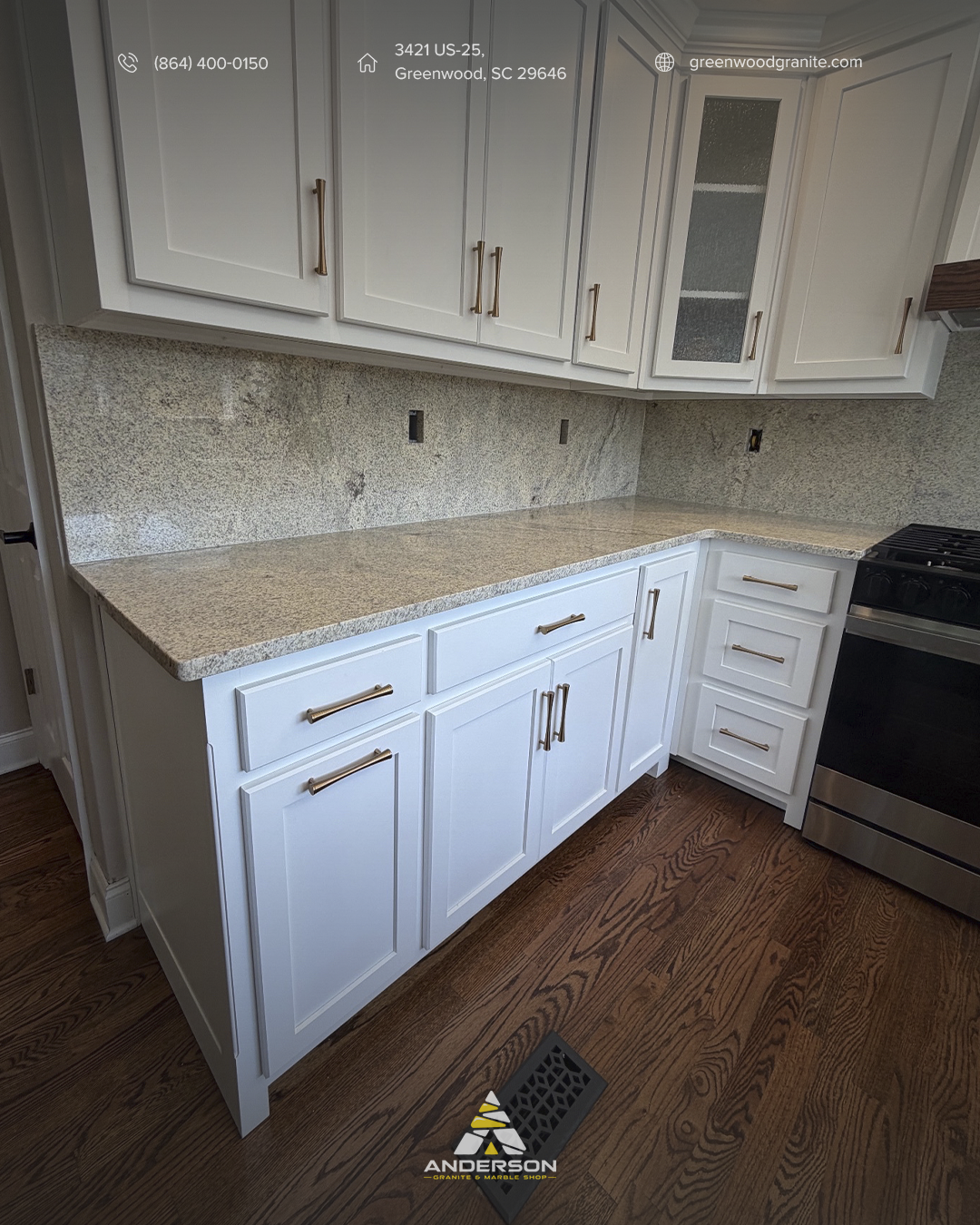
A kitchen island can feel perfectly proportioned until the stools arrive. Then the same island suddenly looks heavier, the walking path feels tighter, and the countertop seems to take up more visual space than it did during installation.
For homeowners researching countertop installers in Waterloo, SC, the problem is often not the island dimensions alone. At Anderson Granite & Marble Shop of Greenwood, we look at countertop color, edge thickness, overhang, stool style, lighting, and pattern together because all of those details affect how crowded the center of the kitchen feels.
Why Can Bar Stools Make a Countertop Feel Bigger?
Bar stools make a countertop feel bigger because they add more visual mass directly under the island edge.
An empty island has one clear horizontal surface. Add three or four stools with backs, legs, footrests, upholstery, and shadows, and the eye starts reading the whole structure as one larger object.
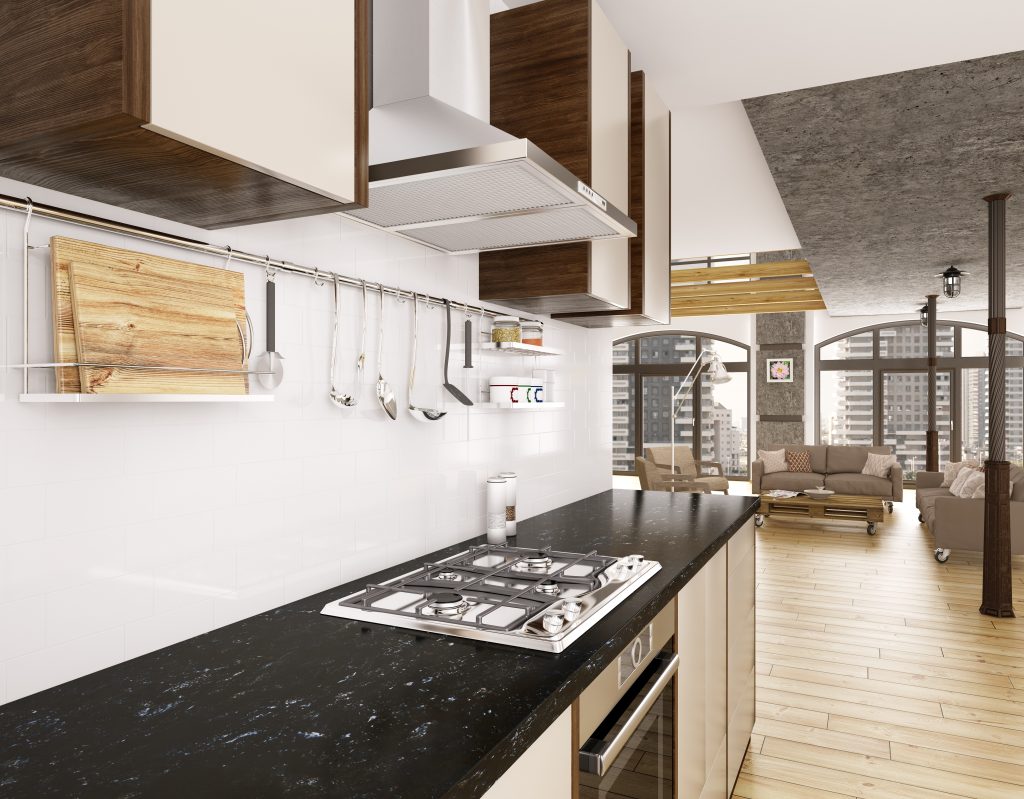
This effect becomes stronger when the countertop is very dark, highly patterned, or visually thick. The island does not actually grow, but the center of the room can feel denser.
| Island condition | Visual effect | Better approach |
|---|---|---|
| Thick dark countertop + bulky stools | Heavy, compressed center | Lighter stone or slimmer stool profile |
| Bold veining + decorative stools | Too many focal points | Quieter surface or simpler seating |
| Low overhang + deep stools | Crowded leg zone | Check seating depth before fabrication |
| Glossy stone + reflective metal stools | More glare and visual activity | Softer sheen or matte seating |

What Countertop Colors Make an Island Feel Lighter?
Light to medium neutrals usually make an island feel lighter after stools are added.
Warm white, pale greige, beige-gray, soft taupe, and muted warm gray reflect more light than black or deep brown stone and create less visual weight. We also prefer colors that connect naturally to the cabinets or floor so the island does not feel like a separate block in the room.
When we help clients compare countertop installers in Waterloo, SC, we often look at the stools and countertop together instead of making those decisions separately. A surface that feels airy with no seating can feel much heavier once dark wood or black metal stools are placed underneath it.
Does Pattern Scale Matter Once Seating Is Added?
Yes. Large, high-contrast patterns can make a stool-filled island feel busier and visually larger.
Strong black veins, bold gold movement, or dense multicolor granite already draw attention. Stool backs, legs, upholstery seams, and footrests add even more lines.
We usually prefer soft mineral movement, broken veining, or moderate pattern on an island with several seats. That gives the surface depth without forcing the eye to process too many shapes at once.
At Anderson Granite & Marble Shop of Greenwood, we often step back several feet when reviewing slab movement because islands are usually seen from across the room, not from twelve inches away.
Can the Edge Profile Make the Island Look Too Heavy?
Yes. A thick or ornate edge can make the countertop look visually heavier, especially when stools sit directly beneath it.
Simple eased, pencil, or small-bevel edges usually help the island feel thinner and cleaner. Laminated edges, deep decorative profiles, or very thick mitered looks can work beautifully in the right room, but they add weight.
For smaller kitchens in Waterloo, SC, we often recommend keeping the edge quiet when the seating itself already has strong visual presence.
How Much Overhang Is Enough for Comfortable Seating?
Most seated islands need roughly 12 inches of overhang for standard counter-height seating, although the exact requirement depends on stool size, support, countertop material, and island construction.
Too little overhang pushes knees outward and forces stools farther into the walkway. Too much overhang can make the countertop itself feel oversized if the support and proportions are not planned carefully.
We also check stool depth. A deep upholstered stool can extend much farther into the room than a slim backless stool, even when both use the same countertop overhang.
How Much Space Should Be Left Behind Bar Stools?
A comfortable aisle behind occupied stools usually needs more room than a simple walking path.
As a practical planning rule, about 36 inches can work for basic passage behind seating, while 42 to 48 inches is more comfortable when people need to walk behind seated guests. Layout needs vary by room, household, appliance doors, and traffic pattern.
When homeowners speak with countertop installers in Waterloo, SC, we encourage them to think about the island with stools pulled out, not tucked neatly underneath. That is the version of the kitchen people actually live with.
Which Stool Styles Make the Countertop Feel Less Dominant?
Slim stools with open backs, narrow legs, and lighter visual weight usually make the island feel less dominant.
Heavy upholstered backs, thick wood frames, and broad bases can make the lower half of the island look crowded. That does not mean homeowners have to avoid comfortable seating, but scale matters.
| Stool style | Effect on island | Best pairing |
|---|---|---|
| Backless stool | Lightest visual footprint | Small or narrow kitchens |
| Open-back stool | Airy but supportive | Medium-size islands |
| Slim upholstered stool | Softer look without too much bulk | Transitional kitchens |
| Heavy full-back stool | Strong visual mass | Larger open kitchens |
| Thick wood frame | Adds warmth and weight | Quiet countertop patterns |
Which Countertop Materials Work Best With Island Seating?
Granite and quartz are often the easiest materials for heavily used islands, while marble and quartzite can also work with the right expectations.
Granite offers excellent heat resistance and natural variation. Quartz is non-porous, does not require sealing, and gives us strong control over color and pattern. Marble offers a softer natural look but can etch from lemon juice, vinegar, wine, tomato sauce, and some cleaners. Quartzite provides excellent heat resistance and natural movement but usually sits at a higher price point.
| Material | Heat resistance | Maintenance | Pattern control | Island practicality |
|---|---|---|---|---|
| Granite | Excellent | Moderate | Medium | High |
| Quartz | Moderate | Low | High | High |
| Marble | Good | Higher | Medium | Moderate |
| Quartzite | Excellent | Moderate | Low to medium | High |
At Anderson Granite & Marble Shop of Greenwood, we match the material to both the room and the household because a family that eats at the island every day has different needs from a kitchen where the island is mostly decorative.
How Much Do Countertops Cost?
Installed pricing depends on material, slab or color selection, edge profile, cutouts, seam complexity, backsplash work, delivery, and site conditions.
Granite typically costs about $45-$120+ per square foot installed. Quartz generally ranges from $55-$140+, marble from $70-$180+, and quartzite from $80-$200+.
| Material | Typical installed range | Main cost drivers |
|---|---|---|
| Granite | $45-$120+ per sq. ft. | Slab, edge, cutouts, layout |
| Quartz | $55-$140+ per sq. ft. | Brand, pattern, waterfalls |
| Marble | $70-$180+ per sq. ft. | Slab selection, finish, vein layout |
| Quartzite | $80-$200+ per sq. ft. | Rarity and fabrication complexity |
Homeowners comparing countertop installers in Waterloo, SC should ask whether digital templating, fabrication, sink and cooktop cutouts, faucet-hole drilling, edge finishing, seam planning, sealing when required, delivery, and professional installation are included.
What Fabrication Details Matter Most on a Seated Island?
Overhang, support, seam location, edge profile, and slab layout matter most.
A seated island receives more contact than most perimeter counters. People lean on the edge, slide stools underneath, set down bags, eat meals, and gather around the same area every day.
A typical project may include:
- Material and finish selection
- Digital templating
- Slab or pattern layout planning
- Seating overhang review
- Sink, cooktop, and faucet cutouts
- Edge fabrication and finishing
- Seam and corner planning
- Backsplash or waterfall fabrication
- Sealing when required
- Delivery and professional installation
At Anderson Granite & Marble Shop of Greenwood, we review these details before fabrication because a small proportion issue around an island becomes much more obvious once stools are installed.
Can a Waterfall Edge Make the Island Feel Smaller or Larger?
It can do either, depending on the slab and room.
A waterfall can make the island feel clean and intentional because it creates one continuous surface. But a dark or highly dramatic waterfall can also turn the island into a large visual block.
We usually consider the floor, cabinet color, stool material, and distance from the island to nearby walls before recommending it.
How Does Lighting Change the Effect of Bar Stools and Stone?
Lighting can make the island feel either lighter or more crowded.
Strong pendant fixtures, glossy stone, reflective metal stool frames, and dark seating can produce several layers of contrast and reflection. Softer lighting and lower-sheen surfaces usually reduce that visual activity.
In Waterloo, SC homes with limited natural light, we often pay extra attention to dark countertops because they can feel significantly heavier in the evening than they do during the day.
How Long Does a Countertop Project Take?
Most countertop projects take about 10-14 business days from final templating to installation when the selected material is available.
Material selection may take 1-5 days. Layout review can take 1-2 days, fabrication typically takes 5-10 business days, and installation is often completed in one day.
Before templating, cabinets should be installed, level, secured, and permanent. We also want sink, faucet, cooktop, appliances, edge profile, seating overhang, backsplash direction, waterfall details, and ideally the general stool dimensions finalized.
What Mistakes Make a Stool-Filled Island Feel Too Crowded?
The biggest mistakes are treating the countertop and seating as two unrelated decisions.
We usually recommend avoiding:
- Very dark stone with several bulky dark stools in a small room
- Thick decorative edges when the seating already feels substantial
- Strong countertop veining with ornate stool backs
- Too little clearance behind occupied stools
- Choosing overhang without checking stool depth
- Large pendants directly above an already visually heavy island
- Selecting the slab without considering the cabinet color below it
The island should feel like one coordinated zone, not a collection of separate statement pieces.
Can We Make an Existing Island Feel Bigger Without Replacing It?
Yes. Changing the stools, pendant fixtures, or surrounding contrast can make a noticeable difference.
Replacing heavy full-back stools with slimmer open-back seating can expose more floor and cabinetry. Moving from a dark stool finish to a lighter wood, neutral upholstery, or thinner frame can also reduce visual weight.
For homeowners who have already worked with countertop installers in Waterloo, SC, these changes are worth testing before assuming the stone itself is the problem.
What Is the Best Countertop for an Island With Several Bar Stools?
The best choice is usually a light-to-medium surface with controlled movement, a simple edge, and enough visual quiet to balance the seating below it.
Warm white, greige, beige-gray, soft taupe, and medium neutral granite or quartz are reliable starting points. We then adjust for cabinet color, floor tone, lighting, stool style, island size, and the amount of natural light.
For many Waterloo, SC kitchens, the island feels best when the countertop does not try to compete with the seating. A surface can still have character, but it should leave enough visual breathing room for the stools, people, and everyday activity around it.
FAQ
Can dark countertops make an island look bigger?
Yes. Dark countertops can add visual weight, especially when paired with dark cabinets or bulky stools.
How much overhang is typical for bar seating?
Around 12 inches is common for counter-height seating, but the final depth depends on stool size, support, construction, and countertop material.
How much space should be behind bar stools?
About 36 inches can work for basic passage, while 42-48 inches is more comfortable when people need to walk behind occupied stools.
Which countertop edge makes an island look lighter?
Eased, pencil, and small-bevel edges usually look lighter than thick laminated or ornate profiles.
Is quartz good for a kitchen island with seating?
Yes. Quartz is non-porous, low-maintenance, and available in controlled patterns that can keep a busy island visually calm.
How much do kitchen countertops cost?
Typical installed ranges are about $45-$120+ per square foot for granite, $55-$140+ for quartz, $70-$180+ for marble, and $80-$200+ for quartzite.
How long does a countertop project take?
Most projects take about 10-14 business days from final templating to installation when the selected material is available.
About Anderson Granite & Marble Shop of Greenwood
Address: 3421 US-25 Greenwood, SC 29646
Phone: (864) 400-0150
Our suppliers: Cambria, MSI Surfaces, Daltile, Moda Quartz, Stone Showcase, Silestone (Cosentino House), Caesarstone, Hanstone, Walker Zanger, Spectrum Quartz, Wilsonart, Cosmos Surfaces.
From Greenwood, SC, we serve Waterloo, SC and nearby communities with material selection, digital templating, slab and remnant layout planning, custom fabrication, sink and cooktop cutouts, faucet-hole drilling, edge finishing, seam and corner planning, backsplash fabrication, waterfall fabrication, sealing, delivery, and professional installation. We work with granite, quartz, marble, and quartzite for kitchens, islands, bathrooms, vanities, and other residential surfaces.
For homeowners choosing countertop installers in Waterloo, SC, we help plan the countertop around the whole seating zone, including material, pattern, edge, overhang, stool depth, lighting, and traffic flow. That extra planning helps the island stay comfortable and visually balanced after the stools are finally in place.