
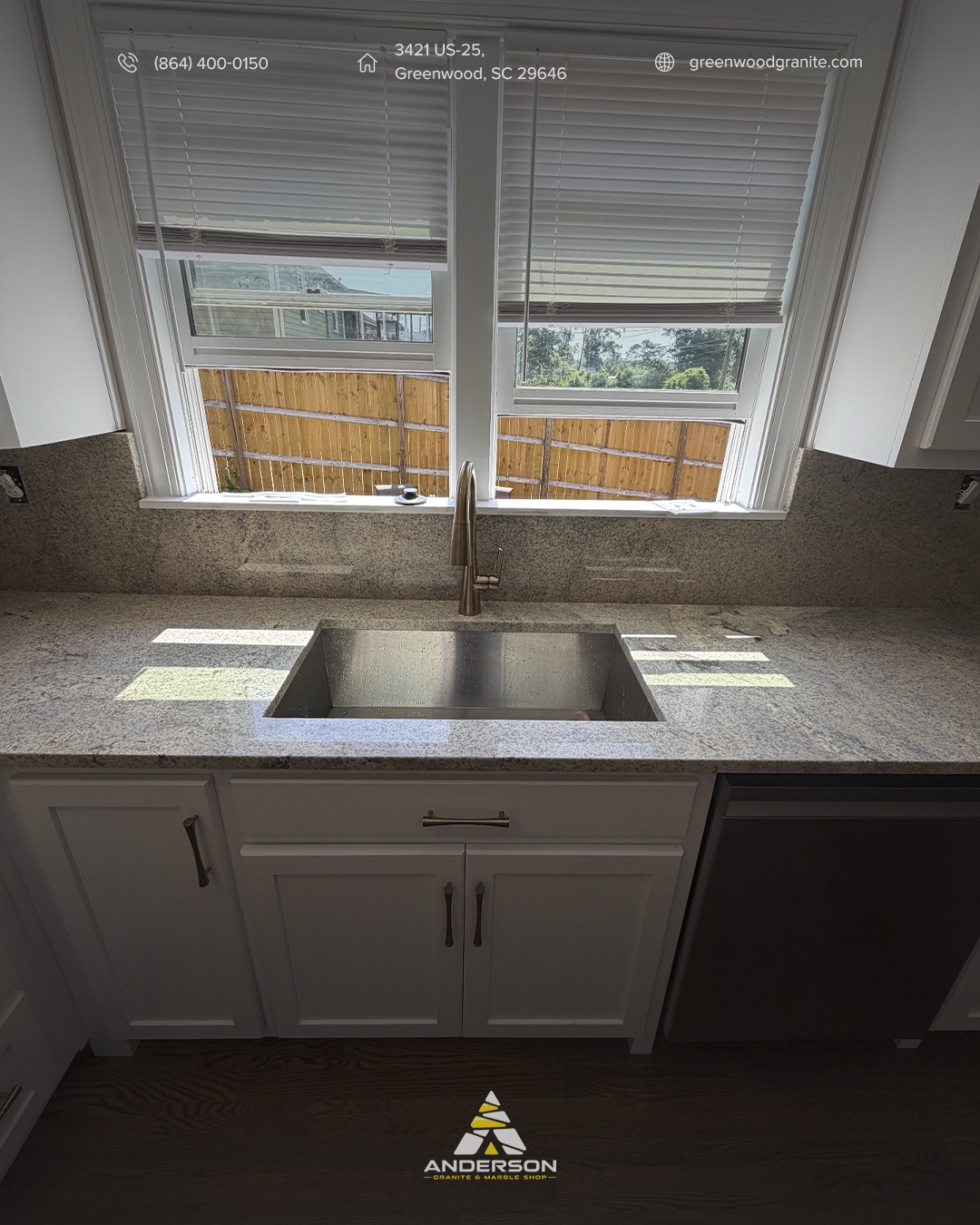
A kitchen island should feel anchored to the room, not like a heavy table that arrived after the rest of the kitchen was finished. We see the “separate furniture” effect when the stone is beautiful by itself but its color, movement, edge, or scale has almost nothing in common with the surrounding finishes.
For homeowners choosing granite countertops in Waterloo, SC, the problem is usually connection rather than quality. At Anderson Granite & Marble Shop of Greenwood, we look at the island cabinet, perimeter counters, flooring, backsplash, lighting, and sightlines together before deciding how dramatic the granite should be.
Why Does a Granite Island Sometimes Look Disconnected?
A granite island feels disconnected when it introduces too many new visual ideas at once.
A dark island base, bright granite, strong veining, and cool pendant lighting can create several contrasts in one place. Even an expensive slab can look accidental when nothing repeats elsewhere in the kitchen.
| Island decision | What creates separation | What creates connection |
|---|---|---|
| Countertop tone | Extreme contrast | Shared undertone |
| Granite movement | Unrelated bold pattern | Movement scaled to the room |
| Edge profile | Thick or ornate | Eased, pencil, small bevel |
| Cabinet color | New isolated color | Color repeated elsewhere |
| Lighting | Cool light on warm stone | Consistent color temperature |

Can a Different Island Countertop Still Look Intentional?
Yes. The island and perimeter do not have to match.
We usually want at least one clear relationship between them: a shared warm undertone, a cabinet color echoed in the granite minerals, matching edge profiles, or a backsplash tone that appears in both surfaces. When selecting granite countertops in Waterloo, SC, we focus on whether the materials belong to the same palette, not whether they are identical.
A contrasting island can feel custom when the contrast has a visual reason.
How Do Undertones Make an Island Feel Separate?
Undertones can create a mismatch even when the obvious colors seem compatible.
Cream granite can turn yellow beside a cool white cabinet. Gray granite can look blue next to warm oak. Beige flooring can also make a stone that looked neutral in the showroom suddenly appear cold.
At Anderson Granite & Marble Shop of Greenwood, we prefer to review cabinet, flooring, paint, and backsplash samples beside the stone whenever possible. These small temperature shifts are much easier to catch before fabrication.
Does Too Much Granite Movement Make the Island Feel Like Furniture?
Yes. Strong movement can turn the island into a standalone statement object.
Large black sweeps, gold veins, or multiple high-contrast mineral clusters naturally pull the eye toward the center of the room. If the perimeter is quiet, the island may start reading more like a decorative table than part of the cabinetry.
| Granite movement | Visual effect | Best fit |
|---|---|---|
| Fine movement | Blends easily | Busy kitchens |
| Medium movement | Balanced character | Most family kitchens |
| Broad low-contrast movement | Custom but connected | Open layouts |
| Strong high contrast | Dominant focal point | Very simple surroundings |
Medium movement often gives natural character without making the island the only thing anyone notices.
Can the Island Cabinet Color Be the Real Problem?
Yes. Sometimes the countertop gets blamed for a disconnect created by the cabinet base.
Navy, black, green, walnut, or another contrasting island color can work beautifully, but it helps when that tone appears somewhere else. Hardware, bar stools, lighting, backsplash details, or even a mineral color in the granite can provide the repetition the eye needs.
A small visual echo is often enough.
Do Edge Profile and Overhang Change How Heavy the Island Feels?
Yes. A thick edge and oversized overhang can make the island feel larger, heavier, and more furniture-like.
Built-up edges create a strong border around the top, while large overhangs can make the slab project too far beyond the cabinet base.
For granite countertops in Waterloo, SC, we often use eased, pencil, or small-bevel profiles when the goal is integration. Overhang should be planned around seating, support, traffic flow, and the actual proportions of the island.
Which Granite Colors Are Easier to Integrate?
Warm white, cream, greige, beige-gray, soft taupe, and balanced gray are usually easier to connect to existing finishes.
The right choice depends on what is already in the room. Warm wood may need a lighter neutral, while painted gray cabinetry may benefit from a warmer granite.
We also look for mineral colors that repeat another surface, such as charcoal near black hardware or cream near warm flooring.
How Do Granite, Quartz, Marble, and Quartzite Behave on an Island?
All four materials can work, but they create different levels of visual movement and maintenance.
Granite offers natural mineral variation and excellent heat resistance. Quartz provides more controlled pattern and does not require sealing. Marble has softer natural veining but can etch from lemon juice, vinegar, wine, tomato sauce, and some cleaners. Quartzite offers excellent heat resistance and dramatic natural movement, usually at a higher price.
| Material | Heat resistance | Maintenance | Island character |
|---|---|---|---|
| Granite | Excellent | Sealer checks | Natural and flexible |
| Quartz | Moderate | Low | Controlled |
| Marble | Good | Higher | Soft and elegant |
| Quartzite | Excellent | Sealer checks | Dramatic and premium |
At Anderson Granite & Marble Shop of Greenwood, we consider both appearance and daily use.
How Much Does a Granite Island Cost?
Granite generally costs about $45-$120+ per square foot installed, depending on slab selection, finish, edge, cutouts, seam requirements, delivery, and site conditions.
Quartz typically ranges from $55-$140+ per square foot installed. Marble often ranges from $70-$180+, while quartzite commonly ranges from $80-$200+.
| Material | Typical installed range | Common cost drivers |
|---|---|---|
| Granite | $45-$120+ | Slab, edge, cutouts, layout |
| Quartz | $55-$140+ | Brand, pattern, waterfalls |
| Marble | $70-$180+ | Slab grade, finish, veining |
| Quartzite | $80-$200+ | Rarity, fabrication complexity |
Homeowners pricing granite countertops in Waterloo, SC should ask whether digital templating, slab layout, sink or cooktop cutouts, faucet-hole drilling, edge finishing, sealing, delivery, and installation are included. Square-foot pricing alone does not always show the full project cost.
Why Does Slab Layout Matter More on an Island?
Slab layout matters because an island usually exposes a large uninterrupted area of stone.
A strong vein placed awkwardly at one edge can make the top feel unbalanced. Directional movement should make sense from the main viewpoints.
At Anderson Granite & Marble Shop of Greenwood, we use layout planning when the slab has noticeable movement. The goal is to decide where the most active areas land before the stone is cut.
What Fabrication Details Help the Island Belong to the Kitchen?
Consistent edges, balanced overhangs, clean cutouts, thoughtful seams, and controlled pattern placement create continuity.
A typical project may include:
- Material and finish selection
- Digital templating
- Slab or remnant layout planning
- Sink and cooktop cutouts
- Faucet-hole drilling
- Edge fabrication
- Seam planning
- Backsplash or waterfall fabrication
- Sealing when needed
- Delivery and professional installation
For waterfall islands, we also plan how movement transitions from the horizontal top to the vertical side. A poor pattern break can make the island look fragmented instead of custom.
How Long Does a Granite Countertop Project Take?
Most granite projects take about 10-14 business days from final templating to installation when the material is available.
Material selection may take 1-5 days, layout approval 1-2 days when needed, and fabrication 5-10 business days. Installation is often completed in one day.
Before templating in Waterloo, SC, the cabinets should be installed, level, secured, and permanent. Sink, faucet, cooktop, appliances, edge profile, overhang, seating plan, and waterfall details should also be final.
What Mistakes Make an Island Look Even More Separate?
The biggest mistake is treating the island as its own decorating project.
We recommend avoiding:
- A dramatically different undertone with no repetition elsewhere
- Bold granite, bold cabinetry, and bold pendants at the same time
- Thick decorative edges in an otherwise simple kitchen
- Oversized overhangs that make the top look table-like
- Cool lighting over a warm stone and wood palette
- Equally busy perimeter and island countertops
- Choosing a slab without cabinet and flooring samples
One strong contrast can create interest. Several unrelated contrasts create competition.
Can an Existing Granite Island Be Made to Feel More Connected?
Yes. Replacing the granite is not always necessary.
Changing pendant color temperature, repeating a granite color in the backsplash, simplifying stools, replacing hardware, or repainting the island base can improve the relationship with the room. If the slab itself is the problem, replacement granite countertops in Waterloo, SC can be selected around the finishes that are staying.
This is often where a quieter slab works better than a more expensive or more dramatic one.
What Is the Best Granite Choice for a Connected Island?
The best choice usually shares an undertone with the kitchen, uses soft-to-medium movement, and has a simple edge.
Warm white, cream, greige, beige-gray, soft taupe, and balanced gray are useful starting points. We then look for mineral colors that repeat the cabinets, floor, backsplash, hardware, or perimeter surface.
For many Waterloo, SC kitchens, an island can still be distinctive without looking separate. Enough visual repetition lets the kitchen read as one room.
FAQ
Should an island countertop match the perimeter?
No. Different materials or colors work well when they share undertones, movement, edge style, or another visual connection.
Can dark granite work on a light island?
Yes. Dark granite can create intentional contrast when the darker color is repeated elsewhere in the kitchen.
What granite movement is easiest to integrate?
Soft-to-medium or broad low-contrast movement is usually the easiest to coordinate with existing finishes.
Does a thick granite edge make an island look heavier?
Yes. Thick or built-up edges increase visual weight and can strengthen the standalone furniture effect.
How much does granite cost?
Granite generally costs about $45-$120+ per square foot installed, depending on slab, finish, edge, cutouts, and fabrication.
How long does a granite project take?
Most projects take about 10-14 business days from final templating to installation when material is available.
Does granite need sealing?
Most granite benefits from periodic sealer checks. Frequency depends on the stone, finish, sealer, and daily use.
About Anderson Granite & Marble Shop of Greenwood
Address: 3421 US-25 Greenwood, SC 29646
Phone: (864) 400-0150
Our suppliers: Cambria, MSI Surfaces, Daltile, Moda Quartz, Stone Showcase, Silestone (Cosentino House), Caesarstone, Hanstone, Walker Zanger, Spectrum Quartz, Wilsonart, Cosmos Surfaces.
From Greenwood, SC, we serve Waterloo, SC and nearby communities with material selection, digital templating, slab and remnant layout planning, custom fabrication, sink and cooktop cutouts, faucet-hole drilling, edge finishing, seam planning, backsplash and waterfall fabrication, sealing, delivery, and professional installation. Our team works with granite, quartz, marble, and quartzite for kitchens, islands, bathrooms, vanities, and other residential surfaces.
For homeowners planning granite countertops in Waterloo, SC, we help coordinate stone with cabinetry, perimeter counters, flooring, backsplash, lighting, overhang, fabrication, and installation so the island feels designed with the kitchen instead of added after it.