

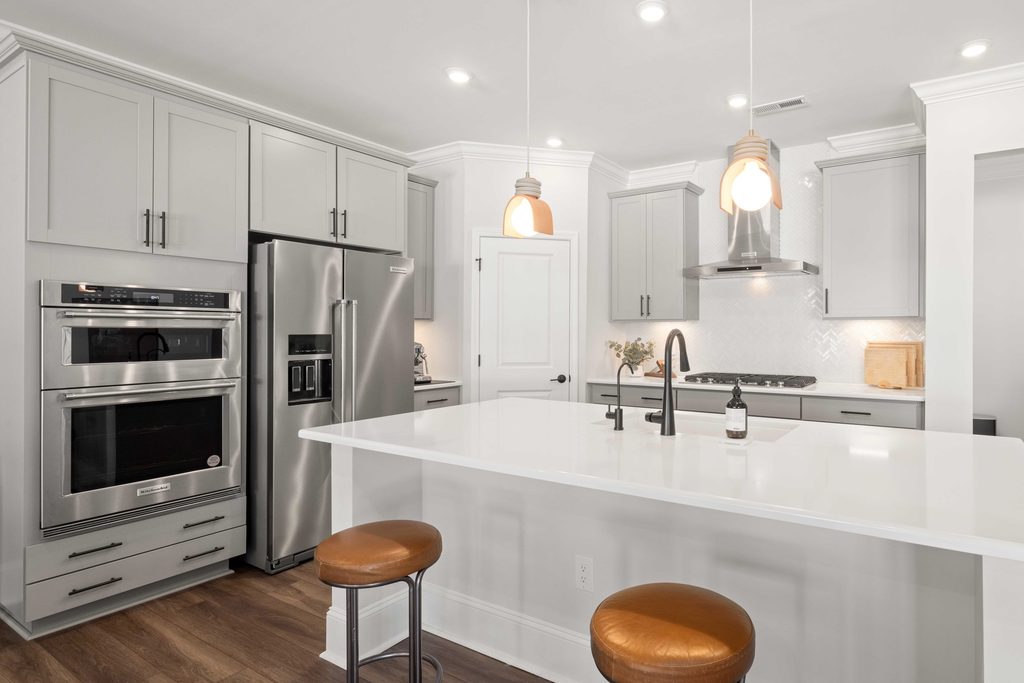
A quartz slab can look calm under showroom lighting and suddenly feel much more dramatic once pendant lights are hanging over the island. We see this when directional light catches the strongest veins, deepens contrast, and makes the pattern look heavier than it did during selection.
For homeowners choosing quartz kitchen countertops in Waterloo, SC, this is one reason we never treat lighting as a separate decision. At Anderson Granite & Marble Shop of Greenwood, we look at vein scale, background color, sheen, pendant placement, bulb temperature, and island size together because all of them affect how loud the finished surface feels.
Why Do Pendant Lights Make Quartz Veins Look Stronger?
Pendant lights make quartz veins look stronger because they create concentrated pools of light instead of even illumination.
A showroom often uses broad overhead lighting that washes the slab evenly. In a finished kitchen, pendants sit closer to the island and create brighter zones directly below each fixture. Darker veins inside those zones can appear sharper, while nearby areas fall into softer shadow.
| Lighting condition | What happens to quartz veining | Typical effect |
|---|---|---|
| Broad showroom light | Light spreads evenly | Veins look softer |
| Narrow pendant beam | Highlights specific areas | Veins look darker |
| Warm 2700K-3000K | Strengthens cream and beige | Pattern feels warmer |
| Cool 3500K-4000K | Emphasizes gray and blue | Pattern feels sharper |

Why Does the Same Quartz Look Different at Night?
The same quartz looks different at night because artificial light becomes the dominant source.
During the day, windows may soften the pattern with broad natural light. After sunset, pendants, recessed cans, and under-cabinet lights create separate directions of illumination. A vein that looked subtle at noon can become the strongest line on the island after dinner.
When we help clients select quartz kitchen countertops in Waterloo, SC, we recommend checking samples under daylight and evening lighting. We want to understand not only the color, but how the pattern behaves when the room is used.
Does Vein Width Matter More Under Pendant Lighting?
Yes. Wider and higher-contrast veins usually become more dominant under focused light.
A broad gray or charcoal vein can reflect differently from the surrounding white or cream background. If the pendant beam hits it directly, the line may appear bolder than it did in a flat sample.
At Anderson Granite & Marble Shop of Greenwood, we usually prefer some variation in vein width. A pattern with one or two dominant veins, softer secondary movement, and quiet areas often feels more natural than one where every line is equally bold.
Can Repetition Become More Obvious Under Pendants?
Absolutely. Repetition is easier to notice when pendants create repeated zones of light across the island.
If a quartz pattern contains similar diagonal veins every few feet, each pendant can visually frame one of those repeats. That can make the surface feel more printed or mechanical, especially across an eight- or ten-foot island.
What Quartz Patterns Stay Calmer Under Strong Lighting?
Quartz with lower contrast, softer movement, and more open background usually stays calmer under pendant lighting.
Warm white, ivory, soft greige, pale taupe, and off-white patterns with diffused veining tend to be easier to live with. Strong black-on-white veins and repeated graphic diagonals usually demand more attention.
| Pattern direction | Under pendant lighting | Best use |
|---|---|---|
| Soft cloudy movement | Usually stays quiet | Large islands |
| Low-contrast taupe veins | Gains gentle definition | Warm kitchens |
| Thin irregular veins | Feels natural | Transitional spaces |
| Bold repeated gray veins | Can become dominant | Minimal rooms |
| Dense veining | Can feel busy | Smaller areas |
For quartz kitchen countertops in Waterloo, SC, we often recommend judging the full pattern from six to ten feet away. Distance reveals whether the slab reads as calm movement or a collection of strong lines.
Does Bulb Temperature Change the Quartz?
Yes. Color temperature can change how both the background and the veins are perceived.
Warm bulbs around 2700K to 3000K can make cream, beige, and taupe quartz feel richer. Cooler bulbs around 3500K to 4000K can pull blue or gray undertones forward, especially in white quartz.
If the quartz has cool gray veining but the rest of the kitchen is warm wood and cream, cooler pendants may make the countertop feel disconnected. We recommend checking the stone under the intended bulb temperature before fabrication.
Can the Pendant Fixtures Themselves Make the Island Feel Busier?
Yes. Large or decorative fixtures add another strong visual element directly above the stone.
A dramatic quartz island under three sculptural pendants can create two competing focal points. At Anderson Granite & Marble Shop of Greenwood, we often recommend giving either the lighting or the countertop the stronger visual role instead of making both equally bold.
Does the Quartz Finish Affect How Loud the Veins Feel?
Yes. Gloss level changes how much light reflects off the surface.
Polished quartz reflects pendants more strongly, which can make highlights and veins feel sharper. A softer or matte finish, when available, can reduce glare and lower contrast between bright and dark zones.
How Does Quartz Compare With Granite, Marble, and Quartzite Under Lighting?
Quartz gives us the most controlled pattern, but natural stones break up light in more irregular ways.
Granite has natural mineral variation and excellent heat resistance. Marble has softer movement but is acid-sensitive. Quartzite offers excellent heat resistance and natural depth. Quartz is non-porous and low-maintenance, but excessive direct heat can damage its resin binders.
| Material | Pattern behavior under light | Heat resistance | Maintenance |
|---|---|---|---|
| Quartz | Controlled, can reveal repetition | Moderate | Low |
| Granite | Irregular mineral variation | Excellent | Moderate |
| Marble | Soft natural movement | Good | Higher |
| Quartzite | Deep natural movement | Excellent | Moderate |
How Much Do Quartz Countertops Cost?
Quartz generally costs about $55-$140+ per square foot installed.
Granite commonly ranges from $45-$120+, marble from $70-$180+, and quartzite from $80-$200+. Final price depends on brand, pattern, slab size, edge profile, cutouts, seams, backsplash work, waterfalls, delivery, and installation conditions.
When pricing quartz kitchen countertops in Waterloo, SC, we recommend confirming whether digital templating, fabrication, sink and cooktop cutouts, faucet-hole drilling, edge finishing, seam planning, delivery, and professional installation are included.
What Fabrication Details Help Keep Veining Balanced?
Slab layout, seam placement, edge treatment, and waterfall direction matter most.
A seam that interrupts a strong vein can make the pattern feel louder because the eye notices the break immediately. A waterfall panel can also extend the same strong movement vertically, increasing its visual impact.
A typical project may include:
- Material and pattern selection
- Digital templating
- Full-slab pattern review
- Sink and cooktop cutouts
- Faucet-hole drilling
- Edge fabrication
- Seam and corner planning
- Backsplash or waterfall fabrication
- Delivery and professional installation
At Anderson Granite & Marble Shop of Greenwood, we review directional patterns before fabrication so the boldest movement does not end up concentrated in one sightline.
How Long Does a Quartz Countertop Project Take?
Most quartz projects take about 10-14 business days from final templating to installation when the selected material is available.
Material selection may take 1-5 days, pattern review 1-2 days, and fabrication usually 5-10 business days. Installation is often completed in one day.
Before templating in Waterloo, SC, cabinets should be installed, level, secured, and permanent. Sink, faucet, cooktop, appliances, edge profile, overhangs, backsplash direction, and waterfall details should also be final.
What Should We Check Before Finalizing Pendant Lights?
We recommend checking placement and bulb temperature against the countertop pattern before the lighting plan is locked.
The most useful checks are:
- Pendant spacing over the island
- Beam spread and fixture height
- Bulb temperature
- Quartz finish
- Location of the strongest veins
- Under-cabinet lighting
- Whether the island is the main focal point
These details are much easier to coordinate before installation than after both the stone and lighting are permanent.
Can We Fix the Problem If the Quartz Already Feels Too Loud?
Sometimes. Lighting adjustments can significantly change how the pattern reads.
Switching to a warmer bulb, widening the beam, raising the pendant slightly, or reducing glare can soften the surface without replacing it. Simplifying nearby decor, stools, or backsplash elements can also give the quartz more visual space.
For quartz kitchen countertops in Waterloo, SC, we recommend evaluating the room at night before assuming the stone itself is the problem. Often the issue is the relationship between light and pattern.
What Is the Best Quartz for a Pendant-Lit Island?
The best quartz usually has enough movement to stay interesting but enough quiet background to absorb directional light.
We look for irregular vein width, lower contrast, softer transitions, and a pattern that remains balanced from across the room. A slab that looks slightly understated in the showroom can feel exactly right once the pendants, stools, appliances, and everyday objects are in place.
FAQ
Why do quartz veins look darker under pendant lights?
Focused light creates stronger contrast between the vein and the background, especially on polished surfaces.
What bulb temperature works best with warm quartz?
Warm light around 2700K to 3000K often supports cream, taupe, beige, and warm-white quartz well.
Can cool LEDs make quartz look grayer?
Yes. Cooler light can emphasize gray or blue undertones that were less noticeable under natural light.
Is subtle quartz better for a large island?
Often, yes. Lower-contrast movement usually stays calmer across long uninterrupted surfaces.
How much does quartz cost?
Quartz generally costs about $55-$140+ per square foot installed, depending on brand, pattern, fabrication, edge, and project conditions.
Does quartz need sealing?
No. Engineered quartz is non-porous and generally does not require sealing.
How long does a quartz countertop project take?
Most projects take about 10-14 business days from final templating to installation when the material is available.
About Anderson Granite & Marble Shop of Greenwood
Address: 3421 US-25 Greenwood, SC 29646
Phone: (864) 400-0150
Our suppliers: Cambria, MSI Surfaces, Daltile, Moda Quartz, Stone Showcase, Silestone (Cosentino House), Caesarstone, Hanstone, Walker Zanger, Spectrum Quartz, Wilsonart, Cosmos Surfaces.
From Greenwood, SC, we serve Waterloo, SC and nearby communities with material selection, digital templating, slab and pattern planning, custom fabrication, sink and cooktop cutouts, faucet-hole drilling, edge finishing, seam and corner planning, backsplash fabrication, waterfall fabrication, delivery, and professional installation. We work with quartz, granite, marble, and quartzite for kitchens, islands, bathrooms, vanities, and other residential surfaces.
For homeowners planning quartz kitchen countertops in Waterloo, SC, we help evaluate pattern scale, vein contrast, pendant placement, bulb temperature, finish, seam layout, and fabrication together so the quartz still feels balanced after the lights are turned on.