
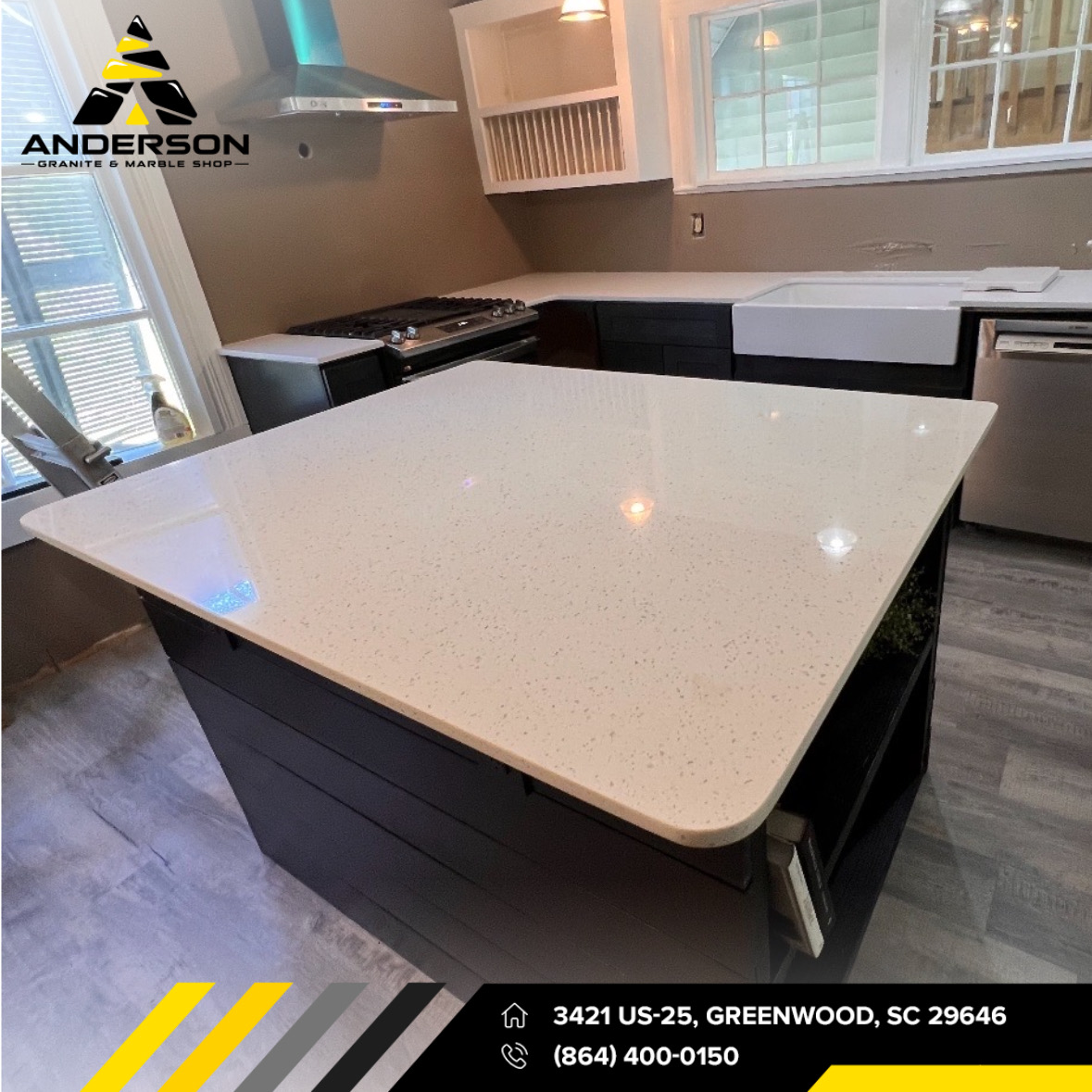
Quartz can crack even when nobody drops a heavy pan, strikes the surface, or causes an obvious accident.
When a crack appears “out of nowhere,” the real cause is often hidden beneath the countertop. Uneven cabinets, poor support, thermal stress, tight appliance openings, or movement around a seam can place continuous pressure on the slab. The crack may not appear immediately. It can develop weeks, months, or even years after installation.
We discuss this with homeowners comparing quartz countertops in Hartwell, GA because quartz is extremely durable, but it is not flexible. A well-made slab still depends on accurate fabrication, stable cabinets, and proper support.
At Anderson Granite & Marble Shop of Greenwood, we help homeowners understand that countertop durability begins long before installation day. We are based in Greenwood, SC and serve Hartwell, GA and surrounding communities with custom fabrication and installation services.
Can quartz really crack on its own?
Quartz does not normally crack without a cause, but that cause may be structural rather than visible.
Engineered quartz contains natural quartz minerals combined with pigments and resin binders. This composition creates a dense, low-maintenance surface with strong scratch and stain resistance.
However, quartz remains rigid. If the cabinets move, the slab is forced across an uneven surface, or heat affects one area sharply, stress can build inside the material.
The countertop may look undamaged until that stress reaches a vulnerable point.
What are the most common hidden causes of quartz cracks?
Uneven support, excessive heat, installation pressure, and weak areas around cutouts are the most common causes.
A crack often follows a predictable path. It may start at an inside corner, sink opening, cooktop cutout, seam, or unsupported overhang.
| Hidden cause | Where cracks often appear | Why it happens |
|---|---|---|
| Uneven cabinets | Across the slab or near seams | Weight is not distributed evenly |
| Weak sink support | Corners of the sink opening | Narrow quartz rails carry extra stress |
| Excessive heat | Near cooktops or appliances | Resin expands differently under heat |
| Tight cutout | Around a cooktop or sink | The slab has no room for minor movement |
| Unsupported overhang | Island edge or seating area | Repeated pressure creates flexing |
| Cabinet movement | Seams and inside corners | The base shifts after installation |
At Anderson Granite & Marble Shop of Greenwood, we inspect support conditions because a strong slab cannot compensate for an unstable foundation.
Can uneven cabinets crack quartz?
Yes. Uneven cabinets are one of the most important structural risks.
Quartz needs to rest on a stable, consistent plane. If one cabinet sits higher than the next, the countertop may bridge a gap or rest on isolated pressure points.
The result can be slow, continuous tension.
That tension is especially risky around sink and cooktop openings, where the slab has already been narrowed during fabrication. Homeowners considering quartz countertops in Hartwell, GA should make sure cabinets are permanently installed, fastened together, and leveled before templating.
Minor inconsistencies may be corrected with approved support methods. Significant cabinet problems should be repaired before the stone is measured.
Why do quartz cracks often start near sinks?
Sink cutouts leave narrow sections of material that carry more concentrated stress.
An undermount sink requires a large opening in the slab. That opening creates thinner rails at the front and back of the sink.
Several problems can affect those areas:
- A sink cabinet may be lower than surrounding cabinets.
- The sink may lack proper independent support.
- The cutout corners may be fabricated too sharply.
- Water may weaken surrounding cabinet material.
- Heavy items may repeatedly strike the narrow front rail.
A crack near a sink does not automatically mean the quartz itself was defective. The location, support, and installation details must be evaluated together.
Can heat crack quartz without direct impact?
Yes. High heat or sudden temperature changes can damage quartz resin and contribute to cracking.
Quartz is heat-resistant, but it is not as heat-tolerant as granite or quartzite. Hot cookware, electric skillets, air fryers, crockpots, and countertop ovens can expose one area to concentrated heat.
The resin in quartz may expand or discolor under excessive temperatures. If the heated area expands while the surrounding surface stays cooler, internal stress can develop.
| Material | Heat resistance | Recommended habit |
|---|---|---|
| Quartz | Moderate | Always use trivets |
| Granite | Excellent | Trivets still recommended |
| Marble | Good | Protect from sudden heat changes |
| Quartzite | Excellent | Use trivets for added safety |
For quartz countertops in Hartwell, GA, we recommend placing heat-resistant pads beneath both hot pans and heat-producing countertop appliances.
Can a dishwasher or cooktop cause quartz to crack?
Yes, if heat, clearances, or support around the appliance were not planned correctly.
Dishwashers release heat and steam beneath the countertop edge. Cooktops create concentrated heat near a large cutout. Both locations require careful fabrication and installation.
A cooktop opening that is too tight can prevent the appliance and countertop from responding safely to normal temperature changes. A dishwasher opening without proper support may leave the quartz spanning a weak area.
At Anderson Granite & Marble Shop of Greenwood, we review appliance specifications before fabrication whenever they affect cutout dimensions or countertop support.
Can an unsupported overhang crack later?
Yes. Repeated pressure can eventually damage an overhang that lacks adequate support.
Kitchen islands often include seating overhangs. People lean on them, children pull themselves upward, and guests place weight near the edge.
Quartz may appear solid, but unsupported material can flex slightly under repeated pressure. Over time, the stress may contribute to cracking near a cabinet corner or support transition.
The required brackets or hidden supports depend on:
- Overhang depth
- Slab thickness
- Island dimensions
- Edge design
- Manufacturer requirements
- Expected daily use
Support should be planned before the countertop is fabricated, not added after a crack appears.
Can seams cause quartz to crack?
A properly planned seam should not cause cracking, but poor support or movement around a seam can create problems.
Seams are normal in larger kitchens. They may be needed because of slab size, transportation limits, layout complexity, or appliance openings.
A good seam should be level, tightly fitted, and supported on both sides. If one cabinet settles or the seam crosses a weak area, the two pieces may move differently.
Warning signs include:
- One side becoming higher than the other
- Bonding material separating
- The seam becoming wider
- A crack extending from the seam
- New movement when pressure is applied
Homeowners ordering quartz countertops in Hartwell, GA should ask where seams will be placed and how those areas will be supported.
Is every line in quartz actually a crack?
No. A natural-looking vein, seam line, surface mark, or resin variation can be mistaken for a crack.
Quartz patterns often imitate marble veining. Some designs include fine lines that continue through the printed pattern but do not affect the surface.
A true crack may feel uneven when a fingernail passes over it. It may also grow, collect residue, change direction, or extend from a vulnerable area.
| What you see | Possible explanation |
|---|---|
| Line follows the printed pattern | Decorative veining |
| Straight line joining two pieces | Fabricated seam |
| Rough line near a sink corner | Possible crack |
| Dark surface mark | Metal transfer or residue |
| Cloudy ring near an appliance | Possible heat damage |
When the cause is unclear, professional inspection is safer than aggressive DIY cleaning or repair.
Are some quartz slabs more likely to crack?
Quality varies, but installation conditions usually matter more than homeowners realize.
Quartz brands use different resin formulas, manufacturing controls, slab thicknesses, and warranty standards. A reputable product offers greater consistency and documented fabrication requirements.
Still, even premium quartz can crack on unstable cabinets.
Factors that affect long-term performance include:
- Slab quality
- Thickness
- Fabrication precision
- Cutout design
- Cabinet stability
- Seam placement
- Overhang support
- Installation workmanship
At Anderson Granite & Marble Shop of Greenwood, we treat material selection, templating, fabrication, and installation as one connected process.
Can a quartz crack be repaired?
Some cracks can be stabilized or made less visible, but not every repair becomes invisible.
The repair method depends on the crack’s size, location, movement, and underlying cause.
A small, stable crack may be filled with a color-matched resin. A crack caused by an uneven cabinet must not be filled until the support problem is corrected. Otherwise, the repaired area may open again.
Possible responses include:
- Color-matched resin repair
- Seam adjustment
- Cabinet reinforcement
- Sink support correction
- Partial section replacement
- Full countertop replacement
A repair should address both the visible crack and the reason it developed.
How much do quartz countertops cost?
Most quartz projects cost approximately $55 to $140 or more per square foot installed.
The final price depends on the quartz collection, slab thickness, edge profile, sink cutouts, seams, backsplash design, and project complexity.
| Material | Typical installed range |
|---|---|
| Granite | $45–$120+ per sq. ft. |
| Quartz | $55–$140+ per sq. ft. |
| Marble | $70–$180+ per sq. ft. |
| Quartzite | $80–$200+ per sq. ft. |
Pricing for custom work may increase with waterfall panels, full-height backsplashes, mitered edges, oversized islands, or detailed vein alignment.
Homeowners comparing quartz countertops in Hartwell, GA should review what the estimate includes rather than comparing slab prices alone.
How long does fabrication and installation take?
Most projects take approximately 10–14 business days from final template to installation.
A standard process usually includes:
| Project stage | Typical timing |
|---|---|
| Material and color selection | 1–3 days |
| Digital templating | One appointment |
| Fabrication | 5–10 business days |
| Installation | Usually one day |
| Plumbing reconnection | Same day or next day |
More complex layouts may require additional time.
At Anderson Granite & Marble Shop of Greenwood, we prefer to finalize cabinet conditions, sink information, appliance specifications, and support requirements before cutting begins.
What should homeowners check before installation?
The cabinets, appliances, sink, and support plan should all be ready before the final template.
A simple preparation checklist includes:
- Cabinets are permanently installed.
- Cabinet boxes are level and secured.
- The sink model has been selected.
- Cooktop dimensions are confirmed.
- Overhang supports are planned.
- Plumbing locations are finalized.
- Damaged cabinet areas are repaired.
- Appliances fit their intended openings.
These details reduce the risk of last-minute adjustments that place unnecessary stress on the finished slab.
What should you do if a crack appears?
Stop applying pressure near the crack and arrange an inspection before attempting a repair.
Do not fill the crack immediately with household adhesive. That may hide important evidence and make a professional repair more difficult.
Take photographs, note when the crack appeared, and check whether it is near a sink, cooktop, seam, appliance, or unsupported edge.
If the countertop is under warranty, review the product and installation terms before altering the surface.

FAQ
Can quartz crack from normal use?
Properly supported quartz should tolerate normal use well, but hidden installation stress can eventually cause cracking.
Can hot pans crack quartz?
Excessive direct heat can damage the resin and contribute to thermal stress. Trivets should always be used.
Does quartz need plywood underneath?
Not always. Support requirements depend on slab thickness, cabinet construction, spans, and manufacturer specifications.
Can uneven cabinets damage quartz?
Yes. Uneven cabinets can create concentrated pressure and stress around seams or cutouts.
Are cracks covered by a quartz warranty?
Coverage varies. Manufacturer warranties may exclude damage caused by heat, impact, poor support, or installation errors.
Can a cracked quartz countertop be repaired?
Some cracks can be filled or stabilized, but the underlying cause must be corrected first.
How long should quartz countertops last?
Quality quartz can last decades when properly fabricated, installed, and maintained.
How long does installation take?
Installation often takes one day after fabrication, while the total template-to-install timeline is commonly 10–14 business days.
Planning a Durable Quartz Installation
Address: 3421 US-25 Greenwood, SC 29646
Phone: (864) 400-0150
Our suppliers: Cambria, MSI Surfaces, Daltile, Moda Quartz, Stone Showcase, Silestone (Cosentino House), Caesarstone, Hanstone, Walker Zanger, Spectrum Quartz, Wilsonart, Cosmos Surfaces.
Quartz performs best when the slab, cabinets, cutouts, appliances, and supports are planned as one system.
Anderson Granite & Marble Shop of Greenwood is based in Greenwood, SC and serves Hartwell, GA and surrounding communities. We provide digital templating, custom fabrication, and professional installation for quartz, granite, marble, and quartzite kitchens, bathrooms, islands, vanities, and other residential surfaces.
For homeowners considering quartz countertops in Hartwell, GA, we help evaluate material selection, cabinet conditions, seam placement, sink support, appliance clearances, and daily maintenance before installation begins.