
A kitchen can have new cabinets, fresh hardware, modern lighting, and expensive stone, yet one countertop decision can quietly date the whole room. We see it when the edge profile feels heavier, more decorative, or more traditional than everything around it.
For homeowners choosing countertops in Waterloo, SC, the detail we watch closely is the countertop edge and its apparent thickness. At Anderson Granite & Marble Shop of Greenwood, we treat the edge as part of the architecture because it runs around every exposed inch of stone and changes how modern, light, or bulky the finished surface feels.
Why Can the Countertop Edge Make a New Kitchen Look Older?
The edge can date a kitchen because it communicates style before most people consciously notice it.
Highly ornate profiles, stacked curves, and thick decorative build-ups can pull a clean shaker or slab-door kitchen toward a more traditional look. That is not automatically wrong, but when cabinets, hardware, and lighting are simple, an overly detailed edge can feel left over from another design era.
| Edge direction | Visual effect | Best fit |
|---|---|---|
| Eased | Clean and quiet | Modern, transitional |
| Pencil | Soft but simple | Contemporary, family kitchens |
| Small bevel | Crisp and tailored | Modern or transitional |
| Half bullnose | Rounded and traditional | Classic interiors |
| Ornate multi-step | Decorative and heavy | Formal traditional kitchens |
| Thick mitered look | Bold and architectural | Large islands |
We usually choose the simplest profile that still supports the design. The goal is not to make the edge invisible, but to keep it from becoming the detail that ages the room first.
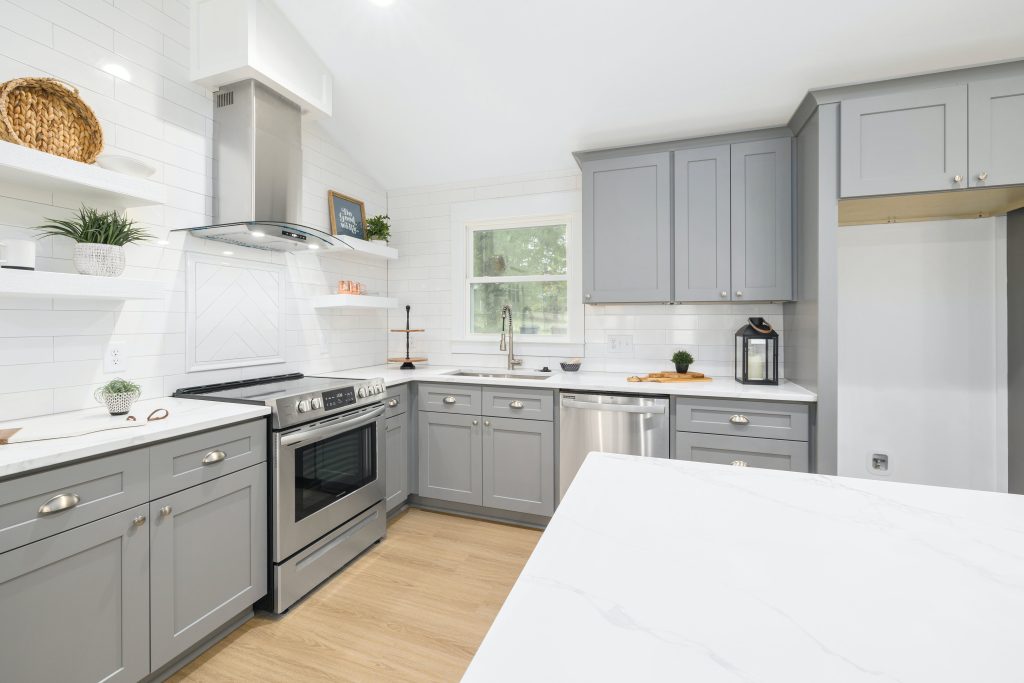
Does Countertop Thickness Matter as Much as the Edge Shape?
Yes. Apparent thickness can change the visual age and weight of a kitchen almost as much as the profile itself.
A very thick-looking countertop can make a small island feel heavy, while an extremely thin top may look out of proportion on substantial cabinetry. The right thickness depends on cabinet style, island size, overhangs, and the room’s scale.
When clients evaluate countertops in Waterloo, SC, we look at the whole elevation instead of choosing thickness from a close-up sample. A detail that looks impressive in a showroom can become overpowering when it runs across eight or ten feet of countertop.
Why Do Ornate Edges Age Faster Visually?
Ornate edges age faster because they are strongly tied to a specific decorative language.
Profiles with several curves, steps, or grooves create more shadows and more lines. If the rest of the kitchen later becomes simpler through new hardware, paint, or lighting, the edge can remain as the one element that still reads heavily traditional.
At Anderson Granite & Marble Shop of Greenwood, we often recommend eased, pencil, or small-bevel profiles when homeowners want a countertop that can survive future design changes.
Can a Simple Edge Still Look Expensive?
Absolutely. Precision often looks more expensive than ornament.
A clean eased edge with consistent polishing, crisp corners, and good seam work can look highly refined because nothing distracts from the material. On granite, quartzite, or marble with strong movement, a simple edge also lets the stone remain the focal point.
Which Edge Works Best With Shaker or Natural Wood Cabinets?
Eased, pencil, and small-bevel edges usually work best because they support clean cabinet geometry without adding another decorative layer.
Natural wood already brings grain, color movement, and texture. White oak, walnut, and stained wood rarely need a busy line directly above them, especially when the stone also has noticeable movement.
Can the Wrong Edge Make an Island Feel Too Heavy?
Yes. Islands show more exposed countertop edge than perimeter runs, so the profile has a larger visual impact.
A thick mitered edge, ornate profile, dark stone, and bulky stools can combine into one large visual block. Even when each choice is attractive separately, the island may dominate the room.
| Island condition | Edge direction we usually consider |
|---|---|
| Small island | Eased or pencil |
| Dramatic slab | Simple eased edge |
| Dark cabinetry | Visually lighter profile |
| Minimal slab doors | Small bevel |
| Large open-plan island | Mitered edge if well proportioned |
How Does the Edge Affect Cleaning and Daily Use?
Simple edges are generally easier to wipe because they have fewer grooves and ledges where crumbs and residue can collect.
Decorative profiles may require more deliberate cleaning, especially around islands used for eating. At Anderson Granite & Marble Shop of Greenwood, we consider maintenance part of the design decision because a beautiful edge that annoys the homeowner every day is not a successful detail.
Do Granite, Quartz, Marble, and Quartzite Need Different Edge Considerations?
Yes. Material affects how the profile looks, how much movement is visible at the edge, and how the detail should be fabricated.
Granite offers excellent heat resistance and works with many profiles. Quartz is non-porous and low-maintenance, but excessive direct heat should be avoided. Marble creates beautiful soft edges but can etch from lemon juice, vinegar, wine, and tomato sauce. Quartzite offers excellent heat resistance and often benefits from a quiet edge that lets its movement lead.
| Material | Heat resistance | Maintenance | Edge tendency |
|---|---|---|---|
| Granite | Excellent | Moderate | Simple edges age well |
| Quartz | Moderate | Low | Clean profiles suit controlled patterns |
| Marble | Good | Higher | Soft simple edges feel natural |
| Quartzite | Excellent | Moderate | Simple edge lets movement lead |
How Much Do New Countertops Cost?
Installed cost depends on material, slab selection, edge work, cutouts, seams, backsplash, delivery, and site conditions.
Granite generally ranges from about $45-$120+ per square foot installed. Quartz commonly costs $55-$140+, marble $70-$180+, and quartzite $80-$200+.
| Material | Typical installed range | Common cost drivers |
|---|---|---|
| Granite | $45-$120+ per sq. ft. | Premium slab, edge, cutouts |
| Quartz | $55-$140+ per sq. ft. | Brand, pattern, waterfalls |
| Marble | $70-$180+ per sq. ft. | Slab grade, finish, layout |
| Quartzite | $80-$200+ per sq. ft. | Rarity, fabrication complexity |
When pricing countertops in Waterloo, SC, we recommend asking whether digital templating, fabrication, sink and cooktop cutouts, faucet-hole drilling, edge finishing, seam planning, sealing when required, delivery, and professional installation are included. A complex edge can also add fabrication cost, so it should earn its place in the design.
What Other Countertop Details Can Make a New Kitchen Look Older?
Several details can reinforce the same dated effect when they are combined.
We pay particular attention to:
- Heavy decorative edges on every exposed side
- Strong brown, gold, or orange undertones that fight newer finishes
- Tiny busy patterns paired with equally busy backsplashes
- Thick dark islands in rooms with limited natural light
- Highly polished surfaces when the rest of the kitchen is matte
- Awkward seam placement through obvious veining
- Short backsplash strips when a cleaner wall treatment fits better
None of these details is universally wrong. The problem starts when they contradict the rest of the kitchen.
Can a Backsplash or Seam Make the Countertop Look More Dated?
Yes. Countertop, backsplash, and seams are visually connected, so weak transitions can make even expensive stone feel less current.
A four-inch stone backsplash can be practical, but in a kitchen designed around large-format tile or a full-height backsplash, it may create an extra horizontal line. Directional veining that stops abruptly at a seam can also draw attention to fabrication instead of the material.
For clients choosing countertops in Waterloo, SC, full-slab review matters when the stone has strong movement. We plan seams around slab size, sink locations, structural requirements, and pattern continuity.
How Long Does a Countertop Project Take?
Most kitchen countertop projects take about 10-14 business days from final templating to installation when the selected material is available.
Material selection may take 1-5 days, layout review 1-2 days, and fabrication 5-10 business days. Installation is commonly completed in one day.
Before templating in Waterloo, SC, cabinets should be installed, level, secured, and permanent. Sink, faucet, cooktop, appliances, edge profile, overhangs, backsplash direction, and waterfall details should also be finalized.
Should We Follow Countertop Trends or Choose Something Timeless?
We usually recommend using trends as inspiration but letting proportion and the house decide the permanent details.
An eased edge works not because it is trendy, but because it fits modern, transitional, coastal, traditional, and warm-natural kitchens without forcing the room into one narrow period.
At Anderson Granite & Marble Shop of Greenwood, we would rather use a current material in a restrained way than stack several highly recognizable trends into one countertop.
What Is the Best Countertop Detail for a Kitchen That Should Age Well?
A clean, proportionate edge is usually the safest long-term choice.
Eased, pencil, and small-bevel profiles work across many cabinet styles and materials. We then adjust thickness, finish, overhang, and seam placement to the actual room.
For homeowners selecting countertops in Waterloo, SC, the best result is a countertop that still feels intentional after the hardware, paint, stools, or backsplash change. The stone may last for decades, so permanent fabrication details should not depend on one short design moment.

FAQ
Which countertop edge looks the most timeless?
Eased, pencil, and small-bevel edges are among the most versatile because they work with many cabinet styles and avoid excessive ornament.
Can a thick countertop make a kitchen look dated?
It can if the thickness feels disproportionate to the cabinetry or room. Thick edges work best when they are intentional and the kitchen has enough visual space.
Are ornate countertop edges outdated?
Not automatically. They can work in formal traditional kitchens, but they may feel mismatched in simpler contemporary or transitional spaces.
Does edge profile affect countertop cost?
Yes. More complex edge fabrication can increase labor and the finished project price.
How much do countertops cost?
Typical installed prices are about $45-$120+ per square foot for granite, $55-$140+ for quartz, $70-$180+ for marble, and $80-$200+ for quartzite.
How long does countertop installation take?
Most projects take about 10-14 business days from final templating to installation when material is available.
Is a simple edge easier to clean?
Usually, yes. Simple profiles have fewer grooves and ledges where crumbs, grease, or residue can collect.
About Anderson Granite & Marble Shop of Greenwood
Address: 3421 US-25 Greenwood, SC 29646
Phone: (864) 400-0150
Our suppliers: Cambria, MSI Surfaces, Daltile, Moda Quartz, Stone Showcase, Silestone (Cosentino House), Caesarstone, Hanstone, Walker Zanger, Spectrum Quartz, Wilsonart, Cosmos Surfaces.
From Greenwood, SC, we serve Waterloo, SC and nearby communities with material selection, digital templating, slab and remnant layout planning, custom fabrication, sink and cooktop cutouts, faucet-hole drilling, edge finishing, seam and corner planning, backsplash fabrication, waterfall fabrication, sealing, delivery, and professional installation. We work with granite, quartz, marble, and quartzite for kitchens, islands, bathrooms, vanities, and other residential surfaces.
For homeowners planning countertops in Waterloo, SC, we help make permanent details such as edge profile, thickness, seam placement, finish, and slab layout fit the architecture of the kitchen instead of locking the room into one short-lived look.