
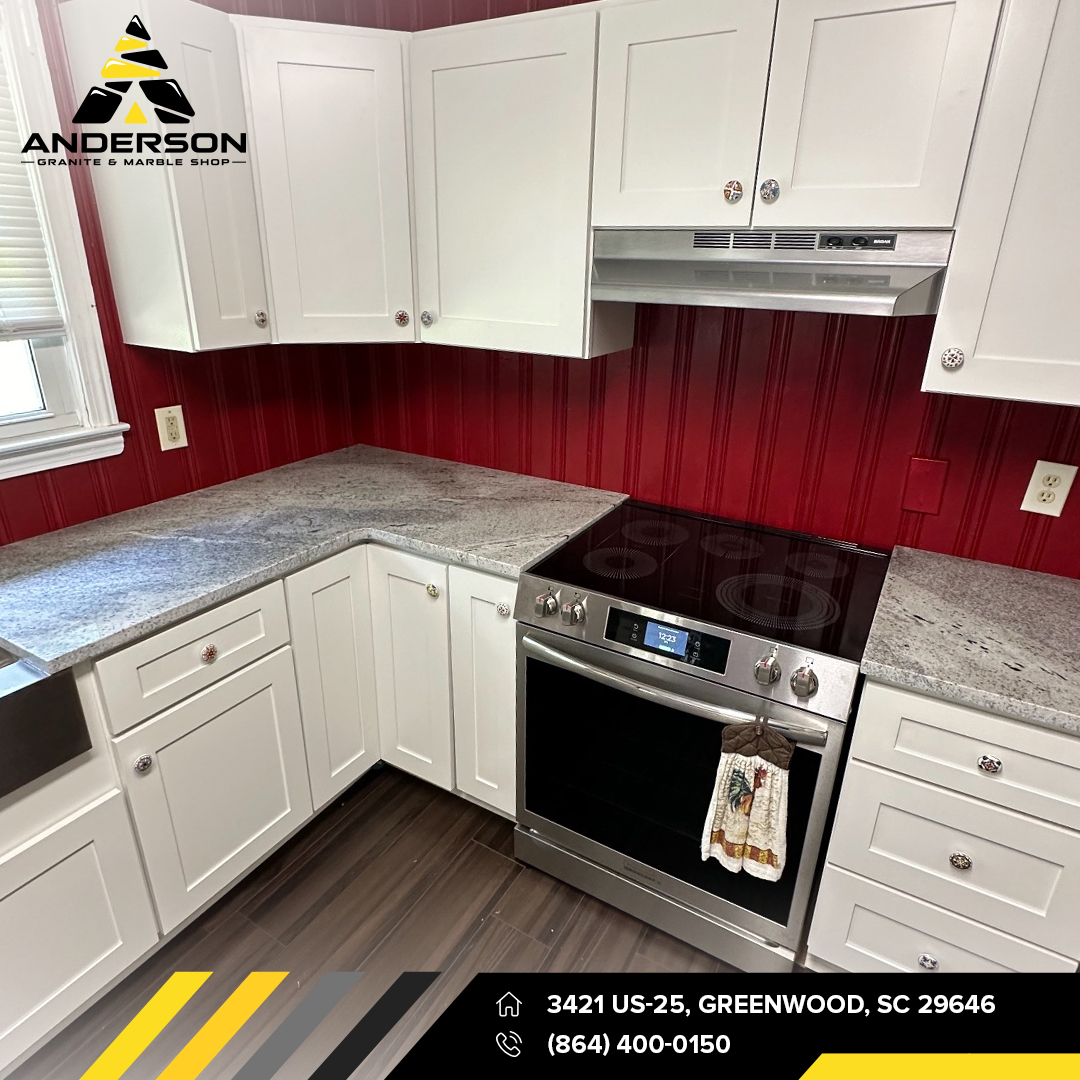
Granite is strong, but it is not flexible. When a heavy slab is installed over cabinets that are twisted, sagging, or out of level, the stone may be forced to carry stress it was never designed to absorb.
We explain this early to homeowners considering granite countertops in Hartwell, GA because cabinet preparation is one of the least visible yet most important parts of a successful project. A beautiful slab and precise fabrication cannot compensate for a weak or uneven base.
At Anderson Granite & Marble Shop of Greenwood, we inspect the supporting structure before final installation. We are based in Greenwood, SC and serve Hartwell, GA and nearby communities with custom countertop fabrication and installation.
Can granite be installed on slightly uneven cabinets?
Minor variations can sometimes be corrected, but significant unevenness must be repaired before installation.
Cabinets are rarely perfect down to the smallest fraction of an inch. A skilled installer may use approved shims or support methods to correct small gaps while keeping the slab properly supported.
The problem begins when cabinet boxes lean in different directions, the run rises and falls noticeably, or separate units are not securely fastened together. Those conditions can transfer tension into seams, narrow cutouts, and unsupported areas.
Correcting the cabinet foundation first is usually easier and less expensive than repairing cracked stone later.
What problems can uneven cabinets cause?
Uneven cabinets can cause cracks, open seams, rocking sections, inconsistent overhangs, and stress around sinks or cooktops.
Granite performs best when its weight is distributed across a stable, continuous base. When one cabinet sits lower than the next, part of the slab may bridge an unsupported space.
The stone can appear fine on installation day and develop a problem months later after repeated pressure, temperature changes, or normal household movement.
| Cabinet problem | Possible countertop result | Warning sign |
|---|---|---|
| Cabinet run is not level | Stress through the slab | Uneven reveal below the edge |
| Boxes are not secured | Movement at seams | Seam begins to separate |
| Sink cabinet is weak | Crack near sink cutout | Fine line at a corner |
| Island is twisted | Uneven overhang | One corner sits higher |
| Dishwasher opening lacks support | Sagging or flexing | Gap beneath the stone |
At Anderson Granite & Marble Shop of Greenwood, we treat these signs as structural concerns rather than cosmetic details.

Why do cracks often appear near sinks and cooktops?
Openings leave narrower strips of stone, so stress concentrates in those areas.
A full slab is naturally strong. Once openings are cut for a sink or cooktop, some sections become thinner and more vulnerable.
If the cabinet below is uneven, the slab may be pulled downward on one side while being supported firmly on the other. That imbalance can contribute to cracking at inside corners or narrow rails.
Homeowners investing in granite countertops in Hartwell, GA should ask how sink rails, cooktop areas, and dishwasher openings will be supported.
Can uneven cabinets cause countertop seams to separate?
Yes. Uneven support can place continuous pressure on seams.
A seam joins two separate pieces of stone. It should be fitted tightly and supported evenly on both sides.
When one cabinet settles or sits lower, the two pieces may no longer remain on the same plane. The seam can become more visible, one side may feel higher, or the bonding material may begin to fail.
Good seam work depends on accurate fabrication, but it also depends on the cabinets remaining stable after installation.
How level do cabinets need to be?
Cabinets should form a stable, consistent plane without abrupt high or low points.
The acceptable tolerance depends on the slab, span, cabinet construction, and fabricator requirements. A long island may need different support than a short bathroom vanity.
We evaluate the complete support system, including whether:
- Cabinet tops align across the full run
- Cabinet boxes are securely connected
- Corners are square and stable
- Unsupported openings have reinforcement
- The island is anchored properly
- Water damage has weakened the structure
At Anderson Granite & Marble Shop of Greenwood, we prefer to identify these conditions before fabrication begins, while corrections are still straightforward.
Should cabinets be leveled before templating?
Yes. Cabinets should be permanently installed, secured, and leveled before the final template is created.
Templating captures the dimensions used to cut the stone. If cabinets move after measurement, the finished pieces may no longer fit correctly.
Post-template changes can affect seam placement, wall gaps, sink alignment, appliance clearances, overhangs, and backsplash dimensions.
For granite countertops in Hartwell, GA, we recommend completing cabinet installation before the template appointment. Sinks and cooking appliances should also be selected according to the fabricator’s preparation requirements.
Can shims fix uneven cabinets?
Small, carefully placed shims may correct minor gaps, but they cannot replace structural cabinet repairs.
Shims must be used correctly so the stone remains supported rather than balanced on isolated pressure points.
A slab should not float across a large gap. Excessive shimming can hide a cabinet problem without solving it.
More serious conditions may require adjusting cabinet legs, refastening boxes, rebuilding a support rail, anchoring an island, or replacing a damaged cabinet section.
Does plywood solve the problem?
Plywood may be part of a designed support system, but it does not automatically level unstable cabinets.
Some countertop assemblies use a plywood subtop while others do not. The correct method depends on stone thickness, edge design, cabinet construction, and project specifications.
If the cabinets beneath the plywood are twisted, the plywood may follow the same uneven shape. Support should be planned for the specific project rather than added as a general fix.
Do granite, quartz, and marble all need level cabinets?
Yes. Every rigid countertop material requires stable support.
Granite, quartz, marble, and quartzite can all crack when forced across an unstable base. Engineered quartz is consistent, but its resin content does not make it flexible enough to ignore cabinet preparation.
| Material | Main strength | Risk on uneven cabinets | Maintenance |
|---|---|---|---|
| Granite | Heat and scratch resistance | Cracks at cutouts or seams | Moderate |
| Quartz | Low porosity | Cracking or seam stress | Low |
| Marble | Classic appearance | Cracks, chips, visible wear | Higher |
| Quartzite | Hardness and heat resistance | Cracking under concentrated stress | Moderate |
Material choice affects daily use, but none of these surfaces should be installed over visibly unstable cabinets.
What does a professional cabinet inspection include?
A professional inspection checks the support conditions that affect fit and long-term performance.
Before installing granite countertops in Hartwell, GA, we look beyond cabinet color and door style. We focus on what will physically carry the slab.
A practical inspection may include:
- Confirming boxes are fastened together
- Checking for high and low points
- Inspecting sink and cooktop support
- Verifying island anchoring
- Reviewing overhang requirements
- Checking appliance openings
- Looking for water damage
At Anderson Granite & Marble Shop of Greenwood, this step helps us separate a minor adjustment from a condition that requires repair before stone installation.
Can old cabinets support new granite?
Yes, if they are structurally sound, level, securely anchored, and properly reinforced.
Age alone does not disqualify cabinets. Older plywood boxes may remain stronger than newer units made with swollen or damaged composite materials.
We look for movement, water damage, separating frames, sagging rails, and floor settlement. If the structure is solid, targeted leveling may be enough. If it is failing, installing new stone on top only hides the problem temporarily.
How much can cabinet correction cost?
Minor adjustments may be inexpensive, while structural repairs can add several hundred dollars or more.
The cost depends on how many cabinets are affected, whether plumbing or appliances must move, and whether damaged sections need replacement.
| Work required | Broad planning range |
|---|---|
| Minor adjustment or refastening | $100–$300 |
| Sink cabinet reinforcement | $200–$600 |
| Island leveling or anchoring | $250–$800 |
| Damaged cabinet replacement | $500–$2,000+ |
| Granite installed | About $45–$120+ per sq. ft. |
These are planning ranges, not fixed quotes. Site conditions and project details determine the actual price.
How long does the project take after cabinets are corrected?
Most standard countertop projects take about 10–14 business days from final template to installation.
| Project stage | Typical timing |
|---|---|
| Cabinet correction | 1–5 days, depending on work |
| Final template | One appointment |
| Fabrication | 5–10 business days |
| Installation | Usually one day |
| Plumbing reconnection | Same day or following day |
Complex layouts, specialty edges, full-height backsplashes, or material availability can extend the schedule.
For granite countertops in Hartwell, GA, fabrication should begin only after the supporting cabinets are ready. Templating an unfinished base creates avoidable fit problems.
What should homeowners check after installation?
The countertop should feel stable, supported, and visually consistent.
Natural stone variations are normal. Structural movement is not.
After installation, check for:
- Even overhangs along cabinet faces
- Smooth transitions across seams
- Clean sink and cooktop cutouts
- No rocking or flexing
- No sudden wide gaps against walls
- No new cracks near inside corners
The installer should also explain normal stone characteristics, seam expectations, cleaning methods, and sealing recommendations.
Is it acceptable to fix the cabinets after the granite is installed?
No. The support system should be corrected before the stone is permanently placed.
Adjusting cabinets afterward can stress the slab and disturb seams, sink attachments, caulk, plumbing, or backsplash work.
The safest order is simple: repair and level the cabinets, create the final template, fabricate the stone, and then install it.
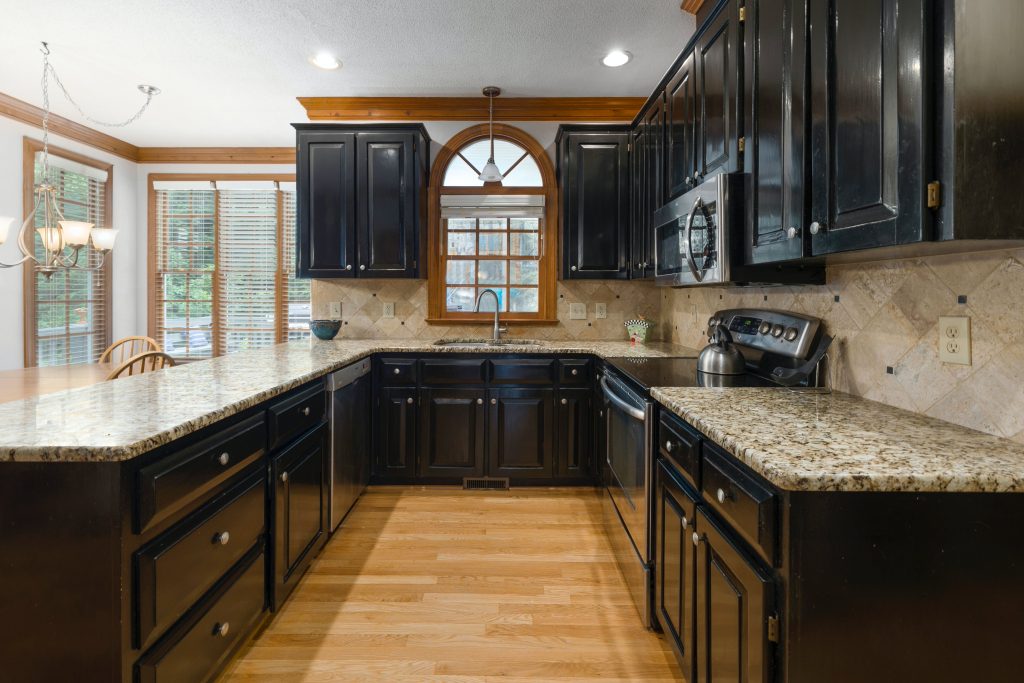
FAQ
Can uneven cabinets crack granite immediately?
Yes, although some cracks develop later as stress accumulates through normal use or cabinet movement.
Can installers level cabinets during countertop installation?
Minor adjustments may be possible, but significant cabinet work should be completed before templating.
Are countertop seams supposed to be invisible?
No. Seams may remain visible, but they should be fitted carefully and supported evenly.
Does granite always need plywood underneath?
No. Support requirements depend on slab thickness, cabinet construction, spans, and fabrication specifications.
Can old cabinets hold granite?
Yes, if they are structurally sound, level, securely fastened, and reinforced where necessary.
Is quartz safer than granite on uneven cabinets?
No. Quartz is also rigid and can crack or develop seam problems on unstable support.
How long does installation take?
Installation often takes one day, while templating and fabrication commonly require 10–14 business days.
Planning a Stable Countertop Installation
Address: 3421 US-25 Greenwood, SC 29646
Phone: (864) 400-0150
Our suppliers: Cambria, MSI Surfaces, Daltile, Moda Quartz, Stone Showcase, Silestone (Cosentino House), Caesarstone, Hanstone, Walker Zanger, Spectrum Quartz, Wilsonart, Cosmos Surfaces.
The most durable countertop begins with a stable foundation. Anderson Granite & Marble Shop of Greenwood is based in Greenwood, SC and serves Hartwell, GA and surrounding areas. We provide templating, fabrication, and installation for granite, quartz, marble, and quartzite kitchen countertops, bathroom vanities, islands, and other custom stone projects.
When homeowners choose granite countertops in Hartwell, GA, we help evaluate not only the slab, color, and edge profile, but also the cabinet conditions that determine how the finished surface will perform over time.