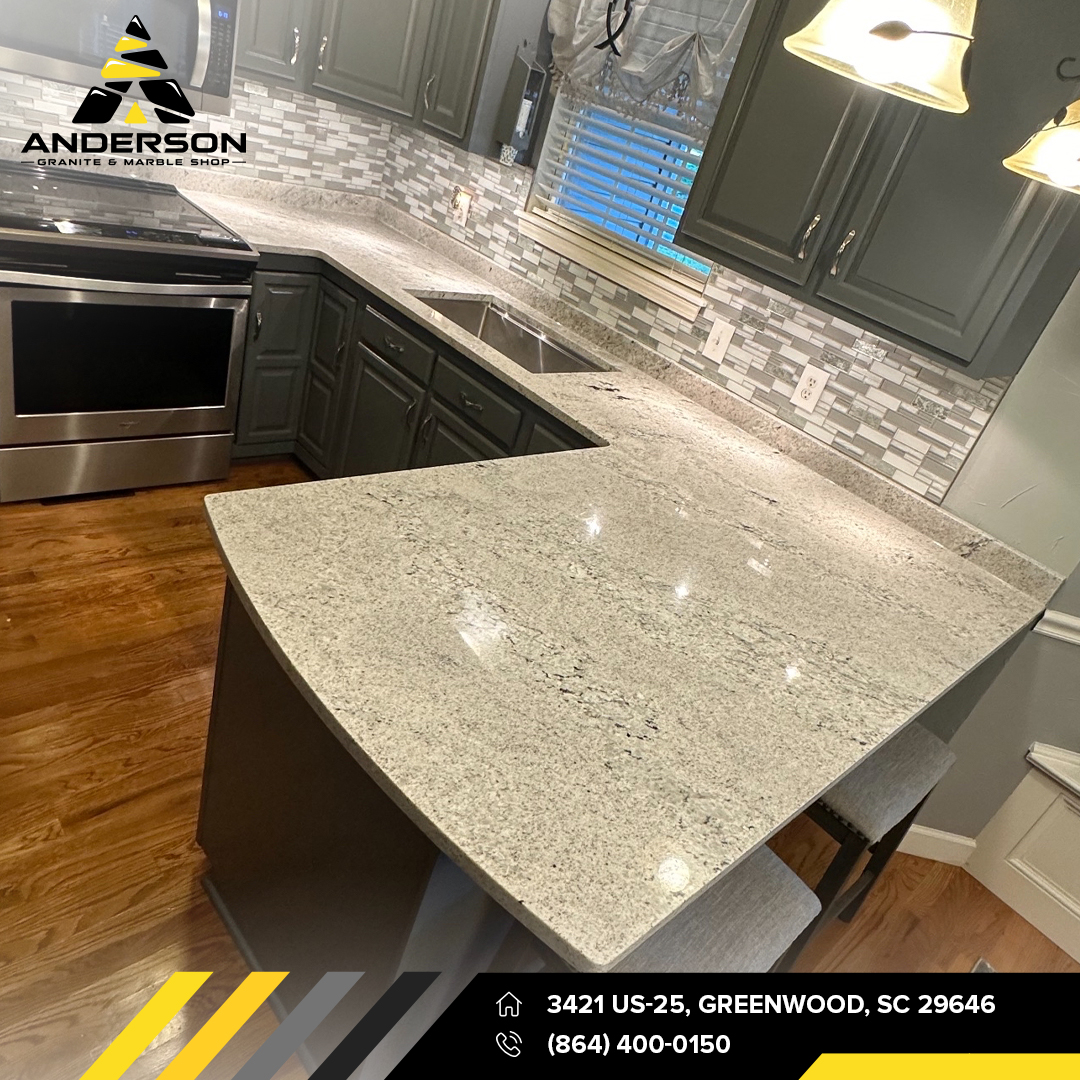
Vein direction matters around corners because the eye expects movement in stone to continue logically from one surface to the next. When veins stop suddenly, reverse direction, or meet at an unnatural angle, even an expensive slab can look incorrectly assembled.
This issue appears most often on L-shaped countertop runs, waterfall islands, full-height backsplashes, mitered edges, and kitchens with several connected stone pieces. The material may be beautiful, but the finished result depends on how that material is cut and positioned.
We discuss this early with homeowners planning custom granite countertops in Hartwell, GA because vein direction cannot be corrected easily after fabrication. The best time to solve it is during slab layout, before the first cut is made.
At Anderson Granite & Marble Shop of Greenwood, we treat corners as part of the design rather than as simple points where two countertop pieces happen to meet.
What Does Vein Direction Mean in Countertop Fabrication?
Vein direction describes the path that visible lines, mineral bands, or flowing movement follow across a slab.
Some granite has soft, cloud-like variation without a clear direction. Other slabs contain long diagonal bands, sweeping mineral movement, or bold lines that travel from one end to the other.
Quartz, marble, and quartzite can also have strong directional patterns. Once that movement is divided into countertop pieces, each cut determines where the visual flow begins, ends, or changes direction.
A fabricator must decide whether the pattern should:
- Continue through the corner
- Turn naturally with the countertop
- Mirror across a seam
- Stop in a visually quiet area
- Become a deliberate contrast
- Align with a waterfall or backsplash panel
There is no single correct solution for every slab. The correct solution is the one that looks intentional in the final room.
Why Do Corners Make Stone Patterns Difficult?
Corners make stone patterns difficult because one flat slab must be divided into pieces that meet at different angles.
A slab is viewed as one continuous image in the warehouse. An L-shaped kitchen turns that image into two perpendicular countertop runs.
If both pieces are cut in the same direction, the vein may appear to stop when it reaches the corner. If one piece is rotated, the movement may turn, but its color balance or mineral orientation may change.
| Corner condition | Main visual risk | Planning priority |
|---|---|---|
| L-shaped countertop | Vein stops abruptly | Create a believable turn |
| Inside mitered corner | Lines meet at the wrong angle | Align dominant movement |
| Waterfall island | Top and side look disconnected | Continue pattern vertically |
| Full-height backsplash | Wall movement conflicts with top | Coordinate horizontal and vertical pieces |
| Corner seam | Pattern shift draws attention | Place seam in a quieter area |
The stronger the pattern, the less forgiving the corner becomes.
Should Veins Turn Around an L-Shaped Corner?
Veins should usually appear to turn naturally or transition calmly around an L-shaped corner.
A perfect continuation is not always possible because the two countertop runs face different directions. The goal is not to force every line to connect exactly. The goal is to prevent a strong vein from crashing into another unrelated pattern.
One approach is to place a calmer section of the slab at the corner. This reduces the need for precise matching.
Another option is to rotate the adjoining piece so the movement appears to follow the shape of the cabinets. That works only when the grain, color, and pattern still look balanced after rotation.
When we plan custom granite countertops in Hartwell, GA, we consider the view from the kitchen entrance, island seating, sink, range, and adjoining rooms. The most visible angle often determines which direction matters most.
What Is the Difference Between Pattern Matching and Bookmatching?
Pattern matching creates visual continuity, while bookmatching creates a mirrored effect between adjoining pieces.
Pattern matching attempts to make veins flow from one piece into another. It is commonly used across seams, corners, backsplashes, and waterfall panels.
Bookmatching uses adjacent slab faces that open like pages in a book. The veins mirror each other, creating a symmetrical image.
| Layout method | Visual result | Best application |
|---|---|---|
| Directional matching | Movement continues naturally | L-shaped runs and long seams |
| Bookmatching | Mirrored, symmetrical pattern | Feature walls and large islands |
| End matching | Pattern continues from slab end | Long countertop runs |
| Random layout | Pieces selected for yield | Quiet or highly speckled material |
| Centered layout | Strong feature placed deliberately | Islands and range backsplashes |
Bookmatching is dramatic, but it does not automatically work around every kitchen corner. It is most successful where the mirrored effect can be viewed as one complete composition.

Do Speckled Granite Patterns Need the Same Planning?
Speckled granite usually needs less directional planning, but color distribution and mineral density still matter.
A granite with small, evenly distributed minerals may hide seams and corners well because it has no single vein that the eye expects to follow.
However, even speckled granite can contain dark clusters, lighter zones, or bands that become noticeable when two pieces meet. One section may look significantly darker than the next if slab layout is ignored.
At Anderson Granite & Marble Shop of Greenwood, we review both strong movement and subtle color variation. Quiet granite still deserves deliberate placement.
Which Materials Are Hardest to Match Around Corners?
Bold marble and quartzite are often the hardest to match, while evenly patterned granite and subtle quartz are generally more forgiving.
Natural stone is unique. Once a specific section is cut out for a sink or island, it cannot be recreated somewhere else.
Engineered quartz offers more pattern consistency, but that can create a different problem. Repeated veins may become obvious when pieces are rotated or placed side by side.
| Material | Corner-matching difficulty | Main challenge |
|---|---|---|
| Speckled granite | Low | Color balance between pieces |
| Directional granite | Moderate to high | Mineral bands must turn naturally |
| Quartz | Moderate | Repeated pattern may become obvious |
| Marble | High | Bold veins can break sharply |
| Quartzite | High | Large movement and slab variation |
Homeowners should not assume engineered material is always easier. A large printed vein can be just as demanding as natural movement.
Why Does Vein Direction Matter on Waterfall Islands?
Vein direction matters on waterfall islands because the top and vertical panel are viewed as one continuous object.
A successful waterfall appears as though the stone folds over the island edge. The vein should either continue down the side or meet the corner in a way that feels deliberate.
This usually requires a mitered joint. The top and side pieces are cut at matching angles so they create a crisp corner with less visible exposed edge.
Poor planning may produce:
- A vein that stops directly at the miter
- Top and side patterns moving in opposite directions
- A major color shift at the corner
- A seam that becomes the island’s main focal point
- Unnecessary slab waste from late layout changes
For custom granite countertops in Hartwell, GA, waterfall decisions should be finalized before slab quantity is calculated. The side panels may require an additional slab.
How Should Veins Flow Into a Full-Height Backsplash?
Backsplash veins should relate to the countertop without creating a confusing collision at the wall.
Some homeowners want movement to rise from the countertop into the backsplash. Others prefer the backsplash to function as a separate framed feature.
Both approaches can work.
A full-height backsplash behind a range may use the slab’s most dramatic section, while the surrounding countertops remain quieter. The layout should account for outlets, range hoods, pot fillers, windows, and upper cabinets before the stone is cut.
A strong vein should not disappear behind an appliance if it could have been placed in a visible area.
Can Vein Direction Affect How Large a Kitchen Feels?
Yes, directional movement can make a kitchen feel longer, wider, calmer, or more fragmented.
Veins that follow a long countertop run can visually stretch the space. Movement that repeatedly changes direction may make the layout feel busy.
On an island, lengthwise veining often emphasizes the island’s size. Crosswise movement can make a narrow island feel wider, but it may require additional seams depending on slab dimensions.
The visual direction should support the room’s proportions rather than fight them.
How Does Slab Layout Work Before Fabrication?
Slab layout maps each countertop piece onto the selected slab before cutting begins.
Measurements from the digital template are arranged over an image or physical view of the slab. This allows us to decide where the island, perimeter, corners, sink, seams, and backsplash pieces will come from.
A practical slab layout process includes:
- Confirming final cabinet measurements
- Recording sink, cooktop, and faucet details
- Identifying strong veins and quiet areas
- Placing major focal pieces first
- Planning corner transitions and seams
- Checking slab yield and waste
- Reviewing the final visual direction
At Anderson Granite & Marble Shop of Greenwood, layout planning is especially important when the customer chose the slab because of one dramatic feature.
Does Better Vein Matching Increase the Price?
It can increase the price because careful matching may require additional slab material, more fabrication time, or lower material yield.
A layout designed only to minimize waste may fit more pieces onto one slab. A layout designed to preserve movement may leave some sections unused or require another slab.
| Cost factor | Why it affects price |
|---|---|
| Additional slab | Needed for better pattern continuity |
| Mitered corners | Require more cutting and edge preparation |
| Waterfall panels | Add material and installation complexity |
| Bookmatching | Requires specific slab sequencing |
| Full-height backsplash | Adds wall templates and fabrication |
| Complex seams | Require added fitting and finishing |
The customer should know whether the estimate prioritizes maximum slab yield or premium visual placement.
How Much Do Stone Countertops Cost?
Installed stone countertops typically range from about $45 to more than $200 per square foot.
The material category provides only a starting point. Slab rarity, finish, thickness, cutouts, corners, edges, backsplash design, and installation access all affect the total.
| Material | Typical installed price | Pattern-planning need |
|---|---|---|
| Granite | $45–$120+ per sq. ft. | Moderate to high |
| Quartz | $55–$140+ per sq. ft. | Moderate |
| Marble | $70–$180+ per sq. ft. | High |
| Quartzite | $80–$200+ per sq. ft. | High |
At Anderson Granite & Marble Shop of Greenwood, we prepare project-specific estimates after reviewing the actual layout and selected material.
Homeowners pricing custom granite countertops in Hartwell, GA should ask whether slab layout review, mitered edges, seam work, and backsplash fabrication are included.
Do Vein Direction and Finish Affect Maintenance?
Vein direction does not change basic maintenance, but pattern and finish affect how stains, scratches, and residue appear.
A busy directional granite may hide crumbs and light marks better than a solid dark surface. Honed or leathered stone may reduce glare but require careful sealing.
| Material or finish | Sealing | Heat resistance | Stain visibility |
|---|---|---|---|
| Polished granite | Usually needed | Excellent | Low to moderate |
| Honed granite | Usually needed | Excellent | Oils may show more |
| Polished marble | Usually needed | Good | Etches are visible |
| Honed marble | Usually needed | Good | Etches blend more easily |
| Quartz | Not required | Moderate | Usually low |
Pattern planning should never replace practical material selection. The surface must still fit the household’s cooking and cleaning habits.
Can a Corner Be Recut After Fabrication?
Sometimes, but major layout changes after fabrication are limited and risky.
A piece may be trimmed if dimensions allow, but adding material back is impossible. Reorienting a completed piece usually means fabricating a replacement.
Natural stone slabs may no longer be available from the same block. Even if the stone name matches, color and movement can differ significantly.
This is why approving corner direction before cutting is so important.
How Are Countertop Corners Installed?
Countertop corners are installed over level, stable cabinets and joined with carefully prepared seams or mitered connections.
The pieces must meet at the correct height. Color-matched adhesive is used at seams, and the joint is adjusted before the adhesive cures.
Cabinet movement can cause even a well-planned seam to become more visible later. The supporting structure should be corrected before installation if it is uneven or loose.
How Long Does Fabrication and Installation Take?
Most countertop projects take about 10–14 business days from final template to installation.
Complex vein matching, waterfalls, bookmatching, or full-height backsplashes may extend the schedule.
| Project stage | Typical timeline |
|---|---|
| Material selection | 1–5 days |
| Digital templating | One appointment |
| Slab layout planning | 1–2 days |
| Fabrication | 5–10 business days |
| Installation | Usually one day |
| Additional backsplash visit | If required |
Before templating custom granite countertops in Hartwell, GA, cabinets should be installed, level, secured, and ready to support the stone. Final sink and appliance specifications are also required.
What Should Homeowners Ask Before Approving the Layout?
Homeowners should ask how the main veins will move across corners, seams, islands, and backsplashes.
Useful questions include:
- Where will the strongest vein appear?
- How will movement change at the inside corner?
- Will the island run lengthwise or crosswise?
- Which areas will be removed for sink and cooktop cutouts?
- Will a waterfall require another slab?
- Where will seams be placed?
- Can the layout be reviewed before cutting?
- Is visual continuity increasing material cost?
Clear answers reduce surprises on installation day.
What Mistakes Make Corner Veins Look Accidental?
The biggest mistakes are prioritizing slab yield over appearance, rotating pieces without reviewing undertones, and placing strong veins directly into seams.
Other common problems include:
- Cutting the island before planning the perimeter
- Ignoring how the kitchen is viewed from nearby rooms
- Using small samples instead of full slabs
- Forgetting backsplash pattern direction
- Adding waterfalls after the slab has been allocated
- Positioning outlets through focal veins
- Assuming every corner can be perfectly matched
- Approving fabrication without a layout discussion
A technically accurate cut can still produce a visually weak result.
FAQ
Must veins match perfectly around every corner?
No. They should transition intentionally, but perfect matching is not always possible with natural stone.
Is granite easier to match than marble?
Speckled granite usually is. Directional granite can require as much planning as marble or quartzite.
What is bookmatching?
Bookmatching places adjoining slab faces together to create a mirrored pattern.
Do waterfall edges need vein matching?
Yes. Pattern continuity strongly affects whether the waterfall appears seamless.
Can quartz veins be matched around corners?
Often, but repeating engineered patterns and slab orientation must be considered.
Does layout planning cost extra?
It may, especially when the design requires another slab, complex miters, or extensive pattern matching.
Can a bad vein direction be fixed after installation?
Usually not without replacing or refabricating one or more pieces.
How long does installation take?
Most projects take about 10–14 business days from final templating to installation.
Planning Vein Direction for Hartwell Kitchens
Address: 3421 US-25 Greenwood, SC 29646
Phone: (864) 400-0150
Our suppliers: Cambria, MSI Surfaces, Daltile, Moda Quartz, Stone Showcase, Silestone (Cosentino House), Caesarstone, Hanstone, Walker Zanger, Spectrum Quartz, Wilsonart, Cosmos Surfaces.
Vein direction matters because corners turn separate stone pieces into one visual composition. Careful slab layout helps movement flow naturally across L-shaped runs, islands, waterfall panels, seams, and backsplashes without making the material feel randomly assembled.
Anderson Granite & Marble Shop of Greenwood is based in Greenwood, SC and serves Hartwell, GA and surrounding communities. We provide digital templating, slab layout planning, custom fabrication, and professional installation for granite, quartz, marble, and quartzite kitchens, islands, bathrooms, vanities, backsplashes, and waterfall applications.
For homeowners planning custom granite countertops in Hartwell, GA, we help evaluate vein direction, seam placement, slab yield, corner transitions, pricing, edge details, and installation requirements before fabrication begins.